The Problem
A cast iron sewer vent stack in a Sydney CBD office tower had started leaking.
The stack ran the full height of the building, from Level 19 down to Level 2, and decades of corrosion had opened up the joints. Building management was dealing with the two things that always follow a failing vent stack: odour complaints from tenants on multiple floors, and water escaping into the building fabric where nobody could see it.
The obvious fix, replacing the stack, was not really a fix at all. It would have meant opening up walls and service ducts across eighteen floors of an occupied commercial building. Weeks of work, displaced tenants, and a bill that would have run well past the value of the pipe itself.
Building management came to us for the alternative.
What we found
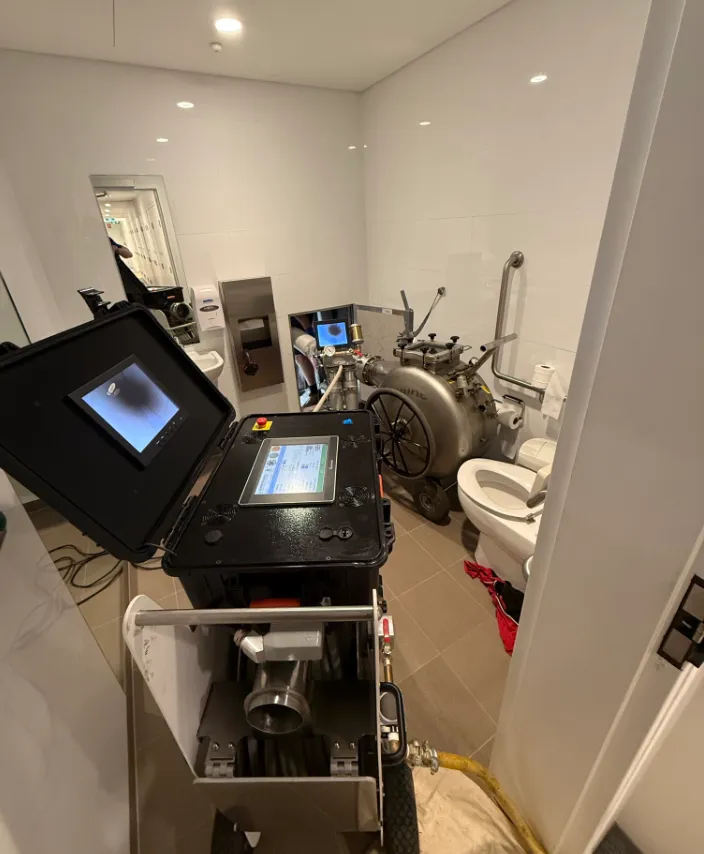
We ran a CCTV camera through the stack before quoting anything.
The footage confirmed corrosion through the full run rather than damage isolated to one or two floors. The cast iron had thinned and cracked at the joints, which is what happens to this material after a few decades in a sewer application. The pipe was still holding its shape, though. That mattered, because a stack that still has structural form is a stack you can reline rather than replace.
We handed the footage to building management along with the quote. They could see exactly what we were seeing.
How we fixed it
The whole job ran across a weekend, split into two half-days of preparation and one full day of UV pipe relining.
1. Access and site set-up. We cleared obstructions blocking access to the stack and opened a single excavation at the base to reach the connecting sewer line. That was the only ground disturbance on the entire job.
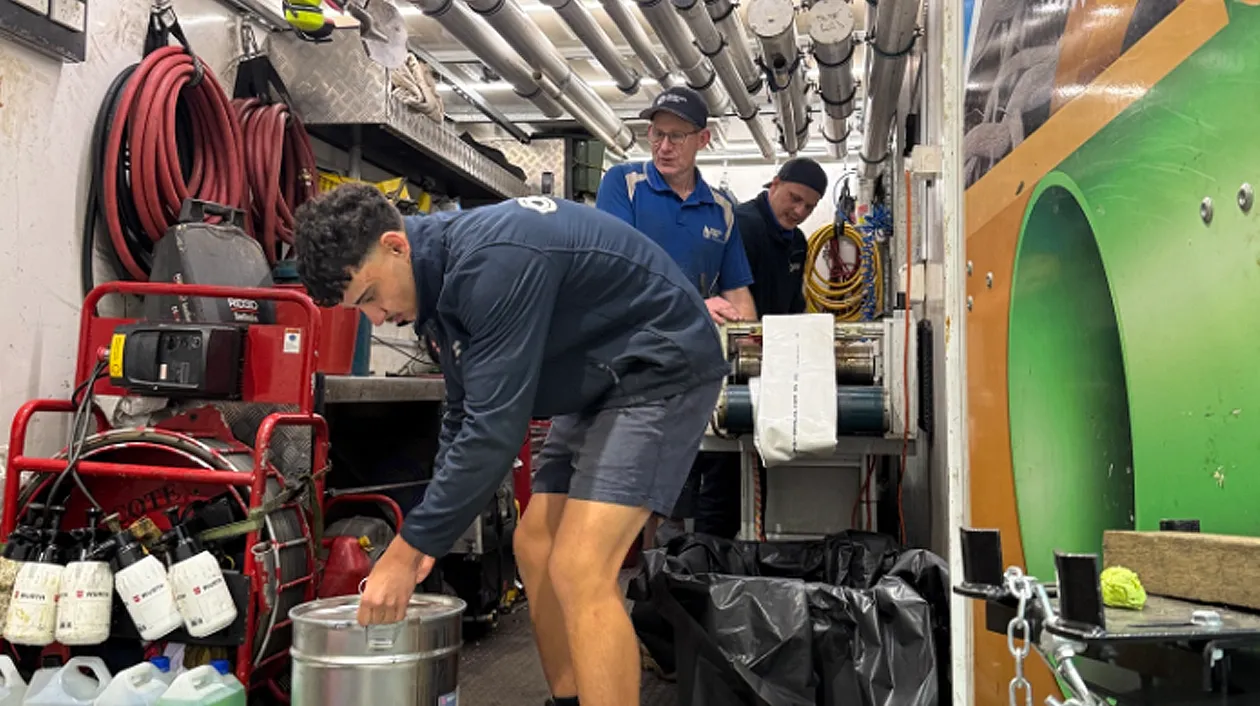
2. Cleaning and surface preparation. The stack was cleaned with high-pressure water jetting to strip out corrosion product and build-up. We then ran Picote chains through it to etch the internal surface. Skip this step and the liner has nothing to grip, it’s the difference between a reline that lasts and one that fails in five years.
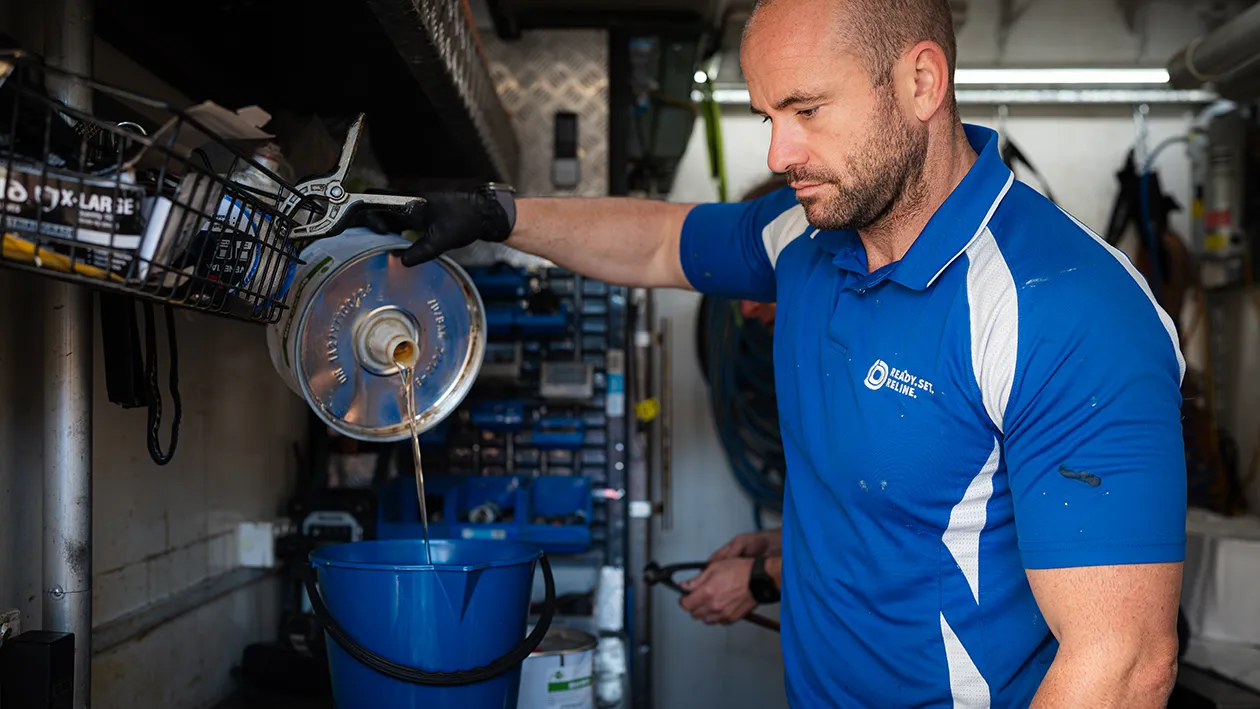
3. Liner installation and UV curing. We impregnated a WaterMark-certified liner with single-part UV resin, then drew it into position across the full run from Level 19 to Level 2. UV light was passed through the liner to cure it in place, forming a new corrosion-resistant pipe inside the old cast iron one.
4. Junction reinstatement. A robotic cutter reopened every branch connection along the stack so each floor’s fixtures drained normally again.
5. Final inspection and reinstatement. A second CCTV run confirmed the liner had cured evenly and the junctions were clean. We trimmed the liner ends, backfilled the excavation, and reinstated the surface.
The challenges
The pipe was the straightforward part. The building was not.
An occupied commercial tower cannot lose its sewer venting during business hours, so building management asked for the work to be done on a Saturday. That compressed the entire scope into a single window with no room to run over.
Working across eighteen levels of a live building also meant coordinating with management on floor access, lift usage and equipment movement, and keeping the team’s footprint out of tenant areas. We staged the preparation work across two half-days beforehand so the Saturday was relining only.
The result
The building had a fully sealed, watertight vent stack by Monday morning, and nobody had to move out.
- No demolition. No walls opened, no service ducts stripped out, no reinstatement bill.
- No tenant disruption. Work was completed inside the weekend window the client asked for.
- Compliant with AS/NZS 3500 Plumbing and Drainage.
- Verified on camera. Post-installation CCTV footage was handed over as a record of the finished work.
- Covered by a 50-year installation warranty.
The relined stack is corrosion-resistant and jointless, which removes the failure point that caused the problem in the first place.
What it means if you have the same problem
Old cast iron stacks in Sydney’s commercial towers are reaching the end of their life at roughly the same time, and most were installed where they are now almost impossible to get at.
If you’re being quoted for replacement, it’s worth getting the stack inspected before you commit. A pipe that has corroded but still holds its shape can usually be relined in place, over a weekend, without touching the building around it. A pipe that has collapsed cannot and the only way to know which one you’ve got is to put a camera through it.
We inspect and quote free, and you keep the footage either way.