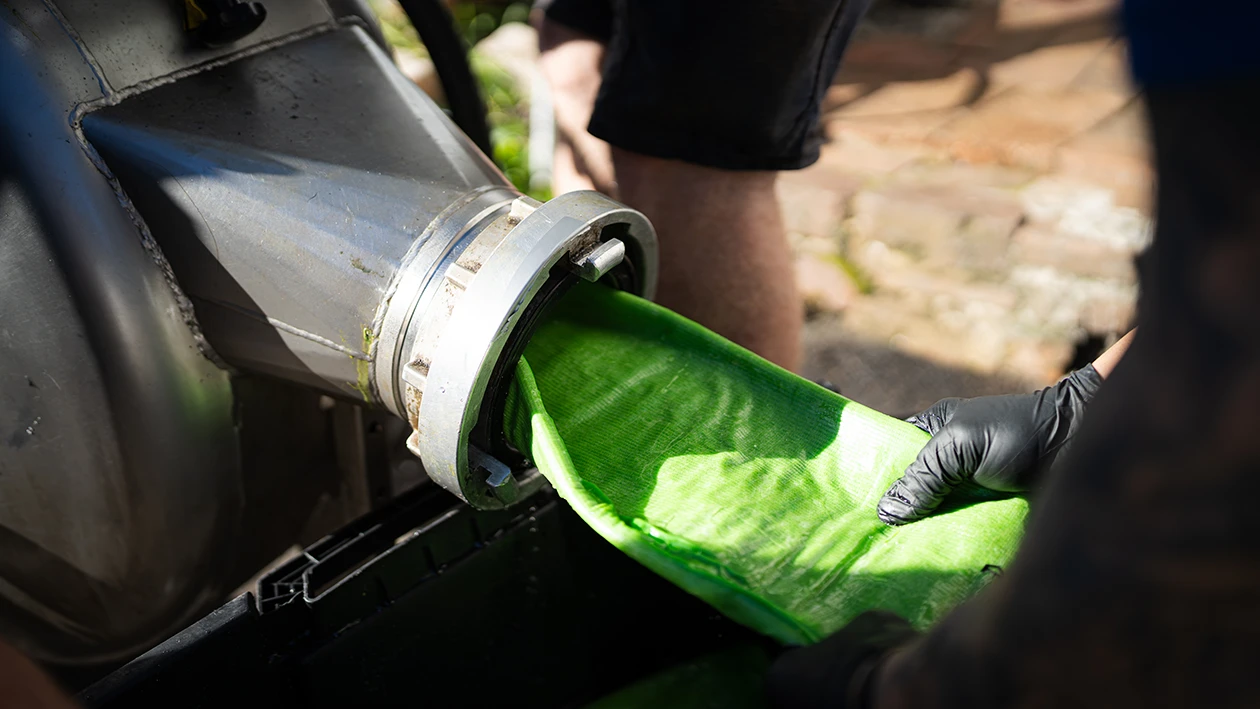
Trenchless pipe relining is a no-dig method of repairing damaged pipes by installing a resin-saturated liner inside the existing pipe and curing it in place, forming a new pipe within the old one, without excavation. The technical name is cured-in-place pipe, or CIPP. A flexible liner made of felt, polyester, poly woven liner, or fibreglass is saturated with epoxy or silicate resin, fed into the damaged pipe through an existing access point, inflated so it presses tightly against the pipe wall, then hardened.
Once cured, the liner forms a seamless, jointless pipe bonded to the inside of the original. It seals cracks and leaks, blocks tree-root intrusion, and is up to four times stronger than PVC. Because the new pipe has no joints, there’s nothing for roots to exploit, which is what makes the repair permanent rather than temporary.
The whole process runs through one access point, such as an inspection opening or boundary trap. Most residential jobs are finished in a single day.
Trenchless vs traditional excavation: the real cost comparison
Comparing these on plumbing cost alone misses the point. The digging is rarely the expensive part, putting everything back is.
Trenchless relining compared with traditional excavation
| Factor | Trenchless relining | Traditional excavation |
|---|---|---|
| Access required | One existing access most of the time | Open trench along the pipe run |
| Time on site | Usually one day | Several days to weeks |
| Crew size | Two to three specialists | Full excavation team |
| Landscaping | Untouched | Dug up and reinstated |
| Driveway, paving, slab | Untouched | Broken out and replaced |
| Road or footpath works | Not required | Permits, traffic control, reinstatement |
| Council permits | Almost never required | Often required |
| Property downtime | Hours | Days or weeks |
| Business disruption | Minimal | Closures, lost trade |
| Warranty | 50 years | Typically 1 year on new pipe |
| Finished pipe | Jointless, root-resistant | New joints roots can re-enter |
The costs people forget: skip bins and spoil removal, traffic control and permits for work near a road, reinstating driveways, paving, retaining walls and gardens, and, for a business, the trading days lost while a carpark sits open.
There’s also a warranty gap worth noting. Relining carries a 50-year warranty, newly laid pipe typically carries one year. The relined pipe is jointless, while a replacement introduces fresh joints for roots to find.
The three types of trenchless relining
Not every damaged pipe needs the same treatment. The right method depends on where the damage is and how much of the pipe it affects.
Inversion relining
The workhorse for long runs. A resin-soaked liner is turned inside out and inverted through the pipe using air or water pressure, so it hugs every bend and surface as it goes. This restores long, continuous lengths in a single installation and reaches sections that would otherwise be inaccessible.
Sectional relining
For isolated damage. Rather than lining the whole run, a shorter liner is placed precisely over a single crack or short damaged length. Faster and more economical when the rest of the pipe is sound. See pipe patch relining.
Junction relining
Pipes branch and connect, and those junctions are the most common failure point. Specially designed liners seal around the branch where two pipes meet, restoring flow and stopping infiltration at the weakest part of the system. See satellite junction repair.
How the liner is cured: four methods
Curing is what turns a soft resin-soaked liner into a rigid new pipe. The method is chosen to suit the pipe material, the site and how quickly you need the drain back.
Curing methods for trenchless pipe relining
| Method | How it works | Cure time | Best for |
|---|---|---|---|
| Ambient | Resin hardens at air temperature | 3.5 – 12 hours pending what resin is used and what the ambient temperature is | Simple jobs with no time pressure or with lots of head pressure and difficult shots |
| Hot water | Hot water circulated through the liner | 40 mins to 1.75 hours | Best for consistent curing |
| Steam | Steam introduced into the liner | 40 mins to 1.5 hours | Best for smaller sections, tricky access and colder conditions |
| UV light | UV-reactive resin cured by a light train | 1.3 meters per minute pending on the light size | When you have the most control over the curing method and great for deep reline as there is no head pressure with loads of water |
UV curing is the quickest, hardening the liner in minutes rather than hours, which matters most where downtime is expensive, like restaurants, strata buildings and commercial sites.
What trenchless relining can repair
One of CIPP’s real strengths is how little it cares about pipe shape.
- Pipe orientations: horizontal runs, vertical stacks, and everything between.
- Pipe shapes: round, square, rectangular and irregular profiles.
- Complex geometry: 90-degree bends, P traps, S traps, offset joints, junctions, elbows and changes in diameter.
- Pipe materials: clay, earthenware, terracotta, PVC, cast iron, copper, concrete and asbestos cement.
Damage it fixes: cracks and fractures, tree root intrusion, corrosion and general deterioration, leaking or separated joints, misalignment, and partial collapse.
Signs you need it: recurring blockages, slow drainage, gurgling fixtures, sewer smells, damp patches or mould, an unusually green patch of lawn, soggy ground that won’t dry, cracked paths, or a failed pre-purchase drain inspection.
Left alone, a damaged pipe doesn’t stay a plumbing problem. Persistent leaks saturate the ground around footings, and in reactive clay soils that can lead to movement and cracking in the structure above. By leaving a leaking pipe, the support under the pipe washes away and the pipe fully collapses, once this happens, the opportunity to reline is gone.
When trenchless relining isn’t the answer
Relining suits the large majority of damaged pipes, but not all of them, and we’ll tell you when it doesn’t.
It isn’t viable when:
- The pipe has fully collapsed, leaving no path for a liner to pass through.
- The pipe is too severely deteriorated to bond to — a liner needs a sound host.
- The pipe is badly out of alignment, where sections have separated and shifted apart.
- The line is significantly undersized for what the property now needs, in which case lining it makes the capacity problem worse.
In those cases the honest answer is replacement, and we’ll walk you through what that involves and what it costs. We inspect on camera first precisely so this is a decision based on evidence rather than a guess. If you are weighing the two options up before you book anything, our guide to relining versus replacement walks through the same decision we make on site, including the three questions that determine which way a job goes.
Trenchless relining for commercial and council infrastructure
For commercial and council assets, the excavation cost is rarely the main problem, the disruption is.
Trenchless relining means no road closures, no digging up the carpark, and no shutting the property. Traffic control, work permits, spoil removal and reinstatement largely disappear from the budget, and businesses keep trading while the work happens beneath them.
- Commercial and industrial — restaurants, retail, offices and factories, with drains back in service the same day.
- Strata and apartment buildings — minimal disruption to residents, with CCTV documentation for owners’ corporations and managing agents. A relined sewer ends the cycle of repeat root-cutting and concrete-breaking that strata budgets absorb year after year.
- Councils and infrastructure — compliant rehabilitation of public stormwater and sewer assets without closing roads or footpaths.
Read more about commercial pipe relining, strata relining and our work with councils.
The environmental case for trenchless
Relining is the lower-impact option, and measurably so.
No major excavation means far less heavy machinery on site, and correspondingly lower emissions. The existing pipe stays in the ground and is reused as the host rather than being broken out and sent to landfill. Established trees, gardens and root systems are left intact instead of being cleared for machine access. And sealing a leaking sewer stops wastewater seeping into surrounding soil and groundwater — which is a genuine environmental benefit, not just a property one.
Why Sydney property owners choose Ready Set Reline
Ready Set Reline is a family-run pipe relining specialist based in Roseville on Sydney’s North Shore, with more than 22 years’ experience across homes, strata, commercial sites and council infrastructure.
Our owner Ryan trained on-site at the Brawoliner factory in Germany, and every job is run to that standard. Brawoliner liners are a woven composite engineered to navigate tight bends and transitions without creasing, which is what allows a single continuous liner through pipework that would otherwise need multiple repairs. Depending on the job, we may use other brand reliners, we choose the best product for the job at hand. Work complies with the Plumbing Code of Australia and uses WaterMark-approved materials meeting AS/NZS 3500.
What every job includes: a CCTV inspection, a fixed written price before we start, our promise to beat any comparable written quote by 10%, before-and-after footage, and a 50-year warranty with a 100% workmanship guarantee.
Licence No. 266660C · ABN 76 167 172 394 · $20M public liability cover · NSW Fair Trading licensed
Book your free quote today
Tell us what’s gone wrong. You’ll get a plan and a fixed price before any work starts.
Call 0422 704 670 — or send the form and we’ll come back to you fast.
- Fixed price in writing
- 50-year warranty
- We beat any comparable quote by 10%
Trenchless pipe relining FAQs
What is trenchless pipe relining?
Trenchless pipe relining is a no-dig repair method that installs a resin-saturated liner inside a damaged pipe and cures it in place, forming a new pipe within the old one. Also called cured-in-place pipe or CIPP, it’s carried out through an existing access point, so no excavation is needed and the finished pipe is seamless and jointless.
How does trenchless pipe repair work?
A flexible liner made of felt, poly weave, polyester or fibreglass is saturated with epoxy or silicate resin, then fed into the damaged pipe by winching or inverted using air pressure. The liner is inflated so it presses against the pipe wall, then cured using ambient air, hot water, steam or UV light. Once hardened it forms a new pipe bonded inside the original, and any lateral connections are reopened with robotic cutting.
What does CIPP stand for?
CIPP stands for cured-in-place pipe, the technical term for trenchless relining. It describes the process of curing a resin-saturated liner inside an existing damaged pipe to form a new one without excavation.
How long does trenchless relining take?
Most residential trenchless relining jobs are completed in a single day. Curing time varies by method, UV curing takes minutes, while ambient curing takes several hours.
Is trenchless relining cheaper than replacing the pipe?
Usually, once the full cost is counted. Relining avoids excavation, spoil removal, permits, traffic control and reinstating driveways, paving and landscaping, which frequently cost more than the plumbing itself. Relining also carries a 50-year warranty, against roughly one year for newly laid pipe.
Can trenchless relining fix pipes with bends?
Yes. Modern liners navigate 90-degree bends, P traps, S traps, offset joints, junctions and changes in diameter, and work in round, square, rectangular and irregular pipe profiles, in both horizontal runs and vertical stacks.
What pipes can be relined?
Trenchless relining works in clay, earthenware, terracotta, PVC, cast iron, copper, concrete and asbestos cement pipe, covering sewer, stormwater, and drainage.
When is trenchless relining not possible?
Relining isn’t viable if the pipe has fully collapsed, is too severely deteriorated for a liner to bond to, is badly out of alignment, or is significantly undersized for the property’s needs. A CCTV inspection confirms suitability before any work is quoted.
How long does a trenchless relined pipe last?
A professionally installed liner is designed to last 50 years or more. Ready Set Reline provides a 50-year installation warranty plus a 100% workmanship guarantee on every reline.
Is trenchless relining environmentally friendly?
Yes. It requires far less heavy machinery than excavation, so emissions are lower; the existing pipe is reused as the host rather than sent to landfill; established trees and gardens stay intact; and sealing a leaking sewer stops wastewater seeping into soil and groundwater.
Do you service my Sydney suburb?
Ready Set Reline is based in Roseville on the North Shore and services all of Sydney, including the Lower North Shore, Northern Beaches, Eastern Suburbs, Inner West, Hills District and the CBD.