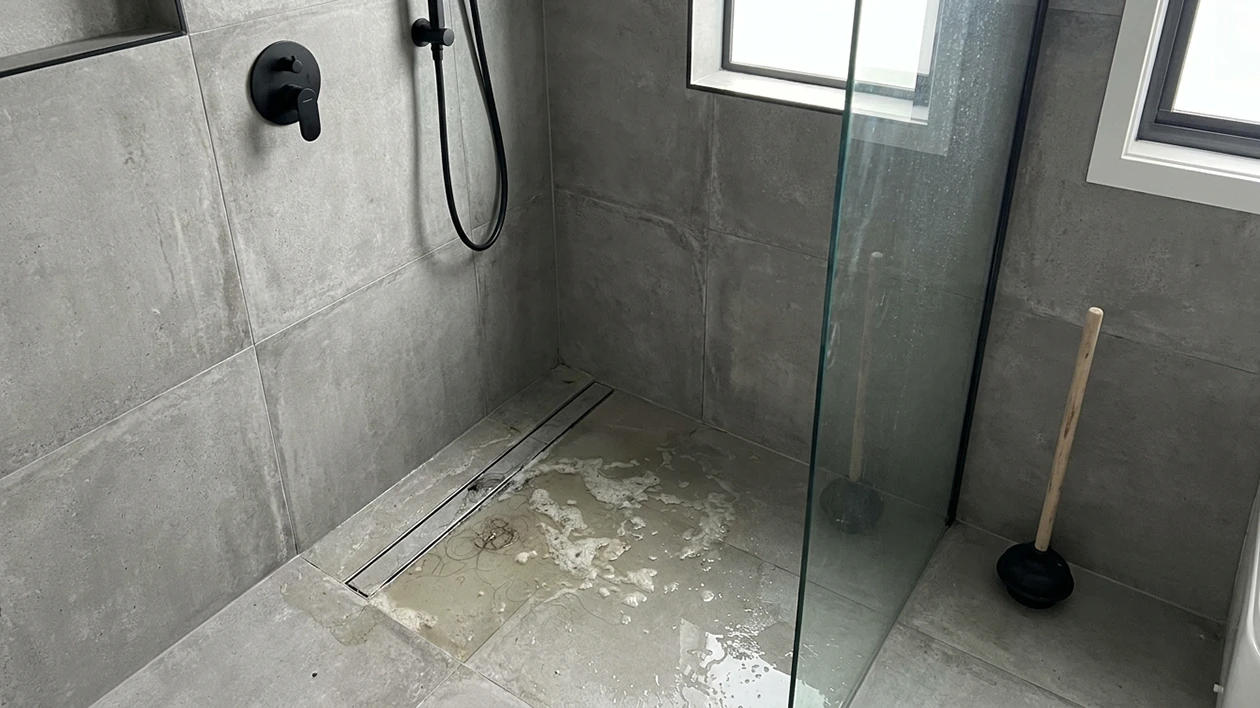
The quickest way to unclog a blocked shower drain is to pull the hair out by hand with a plastic drain snake, then flush the line with hot (not boiling) water and a heavy-duty dishwashing liquid. We don’t recommend caustic drain cleaners or the baking soda and vinegar trick. The first can damage your pipes. The second does nothing to hair.
Most of the time, a slow shower is hair and soap scum knotted together just below the grate. It’s usually a five-minute job. Here’s how we’d do it, and how to tell when the problem is further down the line than a DIY tool can reach.
What Is the Quickest Way to Unblock a Drain Full of Hair?
Get it out by hand. Chemical drain cleaners are a slow way to shift a hair clog. A plastic drain snake costs a few dollars at Bunnings or the supermarket and will pull the blockage out in a couple of minutes.
The Zip-and-Flush Technique
- Take the grate off. Most shower grates lift out with a flat screwdriver or butter knife. If yours is held down with screws, undo them first. Don’t lever against the tiles.
- Feed the drain snake in until it stops. The barbed plastic stick goes straight down the waste (the drain hole under the grate). Push gently. You’ll feel it hit the bend or the clog.
- Twist it a full turn. Rotate the handle 360 degrees so the barbs grab the hair.
- Pull it straight up. Slow and steady. If you yank it, the clump can snap off and drop further down.
- Wipe it off and go again. Keep repeating until the snake comes up clean. Two or three passes is normal.
Wear gloves and have a plastic bag ready. What comes out isn’t pretty.
Try this now: No drain snake in the house? Straighten out a wire coat hanger, bend a small hook into the end, and fish the hair out the same way. Go easy on the sides of the pipe so you don’t scratch it.
Check Your Work
Put the grate back and run the shower for 60 seconds. Drains straight away? You’re done. If it starts pooling over the grate, the main blockage is sitting deeper, usually in the U-bend under the floor, and the snake isn’t reaching it.
Water Still Sitting in the Shower? Use a Plunger
A cup plunger shifts what the snake can’t reach.
- Leave enough water in the shower to cover the cup. The water is what makes the seal. Air just squashes.
- Seal it flat over the waste. If it’s a shower over a bath, block the bath overflow with a wet cloth so the pressure doesn’t escape.
- Give it a dozen firm pumps. Push down, then pull off sharply on the last stroke.
- Run the shower for 60 seconds. If it still pools after two or three rounds, stop there. More force just packs the blockage tighter.
What Do Plumbers Recommend Instead of Drano?
A mechanical tool (a plunger, drain snake or auger) or an enzyme-based drain cleaner. Caustic cleaners like Drano give off a lot of heat as they react, and the pipe under your shower isn’t built for that kind of heat. Hot PVC softens and distorts. If the product doesn’t clear the blockage, you’re then left with a pipe full of caustic water that someone has to work in.
| Method | Risk to pipes | How well it works on hair | How long it takes |
|---|---|---|---|
| Caustic drain cleaner (e.g. Drano) | High. Heat and corrosion risk, toxic fumes | Hit and miss | Minutes to hours |
| Baking soda and vinegar | Low | Poor. Leaves a messy residue | Doesn’t clear it |
| Enzyme drain cleaner | None | Slow. Better on soap scum and oils | Overnight |
| Mechanical drain snake | None | Excellent | A few minutes, with some elbow grease |
What’s actually in the bottle? Caustic drain cleaners are built on sodium hydroxide. One Australian product’s safety data sheet lists it at more than 60% by weight, and warns that when it meets water the reaction may give off enough heat to set nearby combustible materials alight. The same sheet says it corrodes aluminium, tin and zinc, and steel once it’s hot. Zinc is the coating on galvanised steel pipe, which is still found in some older homes. Even the manufacturer’s own instructions tell you to add hot water slowly to avoid a sudden and dangerous reaction. (Blue Lion Supplies safety data sheet)
Best for hair clogs: a mechanical drain snake. It physically removes the blockage instead of trying to dissolve it.
Best for soap scum build-up: an enzyme drain cleaner, left in overnight.
Best for standing water: a cup plunger.
Why Shouldn’t You Use Baking Soda, Vinegar or Boiling Water?
Baking soda (bicarb soda) and vinegar won’t clear a hair clog. Bicarb is a base and vinegar is an acid. Mix them and they cancel each other out, leaving sodium acetate (a salt), water and a burst of carbon dioxide. All that fizzing looks busy. By the time it reaches the clog, it’s mostly salty water.
Nothing in your pantry will dissolve hair. Hair is made of keratin, a protein held together by tough sulphur bonds. It takes a strong alkali like caustic soda, or a specialised enzyme, to break those bonds down, and the caustic soda does it at the expense of your pipes.
Boiling water brings its own problems. PVC drainage pipe is rated to a maximum continuous operating temperature of 60°C. Water straight off the boil is 100°C, around 40 degrees past what the pipe is made to handle (Vinidex). That kind of heat can soften PVC and the glued joints between pipe lengths, and a sudden hit of it can crack a ceramic or acrylic shower base.
Key takeaway: Stop pouring pantry items and kettle water down the drain. If you want a homemade flush that actually does something, use the dishwashing liquid method below.
What Is a Good Homemade Drain Cleaner? (The Dishwashing Liquid Flush)
Heavy-duty dishwashing liquid mixed with hot tap water is the best homemade option for showers slowed by soap scum and body oils. Dishwashing liquid is made to cut grease. That’s what coats the inside of a shower waste.
The Grease-Cutting Flush
- Pour half a cup of dishwashing liquid straight down the drain. A concentrated, grease-cutting brand works best.
- Leave it for 30 minutes. This gives it time to coat the pipe walls and loosen the fatty build-up.
- Run hot tap water for three full minutes. Hot from the tap, not boiling from the kettle. This flushes the loosened scum through the U-bend and into the line.
How to Tell It’s Worked
Listen for a gurgle as the line clears. Then watch the water. When the flow is properly restored, it’ll form a small whirlpool over the waste instead of sitting flat and draining slowly.
This flush works best straight after you’ve snaked out the hair. Snake first, flush second.
My Shower Drain Keeps Getting Blocked. What Next?
Snaked it, used an enzyme cleaner, and it still blocks every few weeks? The problem probably isn’t in your shower. It’s more likely a partial blockage further along the line: a build-up in the main drain, a sagging section of pipe that holds water and debris, or tree roots getting in through a cracked joint.
Signs the Problem Isn’t in Your Shower
Call a plumber straight away if water comes up through the shower when you flush the toilet or the washing machine drains. The same goes for a floor waste that gurgles, or a sewer smell that doesn’t clear after running the shower for 30 seconds. Those point to a blockage in the main line, and no amount of work at the grate will fix it.
If several drains back up at once, the blockage could be in your private sewer line or in Sydney Water’s main. We’ll find out which with a camera, so you’re not paying to fix something that isn’t yours. In an apartment, if your neighbours’ drains are slow too, tell your strata manager. It’s likely a shared stack.
What to Do
-
- Put a hair catcher in today. A silicone drain protector or a mesh hair catcher sits in the waste and stops hair before it gets into the pipe. They usually cost under $20 and are the cheapest bit of plumbing maintenance you’ll ever do.
- Do an enzyme flush once a month. It keeps soap scum and oils from building up between cleans.
- If it blocks again within 30 days, call a plumber. A drain that keeps coming back needs to be looked at properly. Ready Set Reline will clear it with high-pressure jetting and run a CCTV camera through the line so you can see exactly what’s causing it, whether that’s a build-up, a damaged section that can be relined without digging or roots. Once you know what’s down there, you can fix the cause instead of clearing the same blockage every month.
Want to speak to someone about your blocked shower drain? Give Ready Set Reline a call on 0422 704 670 we’d be glad to help!