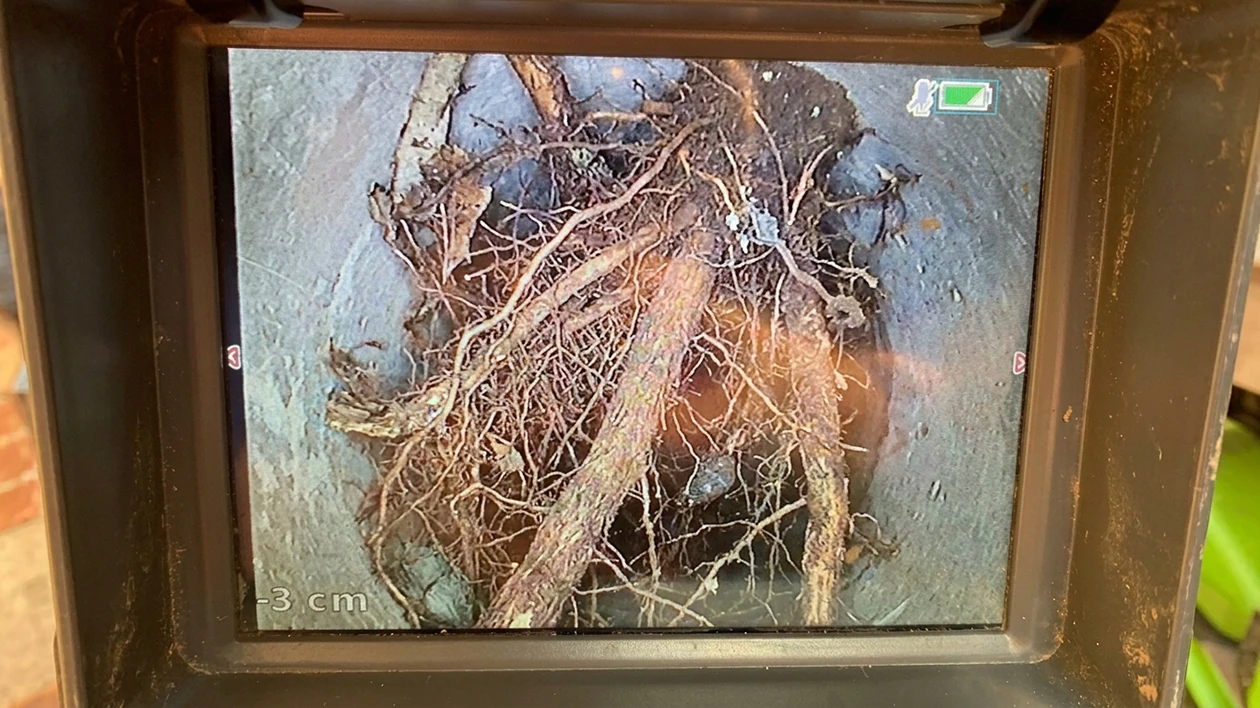
Roots do not usually break pipes. They find pipes that are already broken.
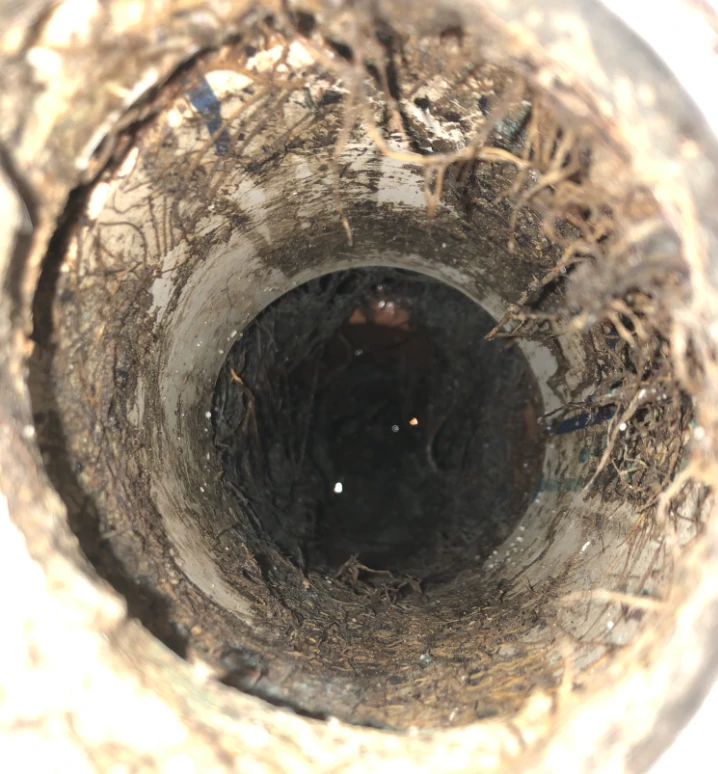
The City of Sydney’s own fact sheet on the subject puts it plainly, it is rare for a tree root to crack into a properly installed and well-maintained pipe. Roots get in through failed joints, deteriorated seals and existing cracks, most commonly in old terracotta lines where soil movement has opened the joints up. That is why cutting the roots never ends it. The opening is still there.
The fix has three parts. Clear the root mass, treat what is left so it dies back, then seal the pipe so there is nothing for the next lot of roots to find. Skip the third step and you will be doing this again next year.
How to Remove Tree Roots from Pipes
Clear the blockage first with a motorised drain machine or high-pressure jetter so water is flowing again. Once the line is open, apply a foaming root treatment to kill the fine root hairs left behind in the joints. Then reline or repair the pipe so the fault the roots came through is gone for good.
The three-step protocol
Step 1: Find the inspection opening. Look for a white or grey PVC cap sticking out of the ground, usually near the side of the house, in a garden bed, or close to the boundary fence. Older Sydney homes sometimes have a brass or terracotta cap instead. This is your access point to the sewer. It is the first thing a plumber will ask about.
Step 2: Clear the roots physically. A motorised drain machine, or plumber’s eel, chews through the mass with a cutting head. High-pressure jetting does a better job. It scours the pipe walls instead of punching a hole through the middle of the root ball. Punch a hole and the line drains again, but the roots are still in there. They close back over within months.
Where the root mass has gone hard and woody, or where it has grown through a junction, cutting it out takes a robotic cutter rather than an eel.
Step 3: Treat, then seal. A foaming root treatment coats the full circumference of the pipe, including the crown where a liquid poured down the toilet never touches. That kills the remaining root hairs over a few weeks. The seal comes last. It is the part that actually ends the cycle.
Do this now if your drains are backing up
- Stop using water in the house. No showers, no washing machine, no flushing. Every litre you send down the line has nowhere to go and will come back up through the lowest fixture in the house, usually a downstairs shower or the overflow gully outside.
- Find the overflow relief gully, the short grated pipe outside at ground level. If it is spilling, that is the system working as designed and keeping sewage out of your house. Do not block it.
- Locate the inspection opening so you can point a plumber straight at it.
The mistakes people make
Boiling water. It does not travel far enough down a sewer line to be above lukewarm by the time it reaches the roots, and on PVC or HDPE it can soften joints. It has never cleared a root blockage.
Bleach or drain cleaner down the toilet. Caustic drain products are made for hair and grease in a basin trap a metre away. Diluted across twenty metres of sewer, they do nothing to a woody root mass. All you have done is tip a corrosive product into your drainage.
Clearing without inspecting. If nobody puts a camera down the line afterwards, you do not know whether you cleared a root ball, a collapsed section, or a sagging length of pipe holding water. All three feel identical from the sink.
What good looks like
Water should be draining freely within a couple of hours of a mechanical clear, and gurgling should stop entirely. Chemical treatments work on a slower clock, with root die-back over roughly two to four weeks. If the line slows again inside six months, the fault is wide enough that treatment alone will not hold it.
How Often Is It Actually Roots?
Roots are not one cause among many. They are the cause.
Sydney Water’s asset team, working with CSIRO’s Data61, analysed roughly 300,000 blockage records from its network between 2001 and 2016. Tree roots were recorded as the cause of 80 per cent of Sydney Water’s sewer blockages in dry conditions. Chokes cost the utility and its customers over $10 million in 2015.
That is Sydney Water’s mains, and its network runs to around 25,000km of pipeline. The house drains we open up are older and smaller than that, and they run straight under the garden. In most Sydney suburbs, roots in the line are a when, not an if.
What Dissolves Tree Roots in Sewer Lines (Bunnings and Natural Options)
The products that genuinely kill roots inside a sewer are foaming root treatments containing a root-inhibiting herbicide, sold through plumbing suppliers and some hardware stores. Copper sulphate crystals are the old-school option and still get recommended online, but several Australian water authorities discourage or restrict tipping them into the sewer. Rock salt and vinegar mixes are folk remedies that will not touch an established root mass.
What to look for on the shelf
Ignore the marketing on the front and read the active ingredient on the back. You want a foaming product, because foam expands and holds against the top and sides of the pipe where roots actually enter. A liquid runs along the bottom and treats nothing.
Be careful with product names you find on forums. A copper-based garden fungicide is not a drain root killer, even though both say “copper” on the tin. The garden product is for leaf spot and mildew on plants, and pouring it into your sewer achieves nothing.
Check your water authority’s rules before you tip anything into the sewer.
The DIY mixes, honestly assessed
| Method | What people claim | What actually happens |
|---|---|---|
| Rock salt | Dehydrates and kills roots | Very slow, needs repeat dosing, kills lawn and garden plants near the line, and does nothing to a mass thicker than a pencil |
| Boiling water | Cooks the roots | Cools well before it arrives, risks softening PVC joints |
| Vinegar and bicarb | Dissolves the blockage | Fizzes in the bowl, reaches the roots as slightly acidic water |
| Foaming root treatment | Kills roots and inhibits regrowth | Works, but only on residual hairs after the mass is mechanically cleared |
Checking whether it worked
Run a tap and listen at the nearest gully three days after treatment. Steady flow with no gurgle is a good sign. Gurgling means air is being forced past something still sitting in the line, and no chemical is going to shift a root mass that size. That is a cutting job.
Can I Do Hydro Jetting Myself Using a Pressure Washer?
You can buy a sewer jetter kit that fits a domestic pressure washer, and it will clear light debris and fine roots from a short run. It will not cut a mature root mass, and used in an old terracotta line it can blow out joints and turn a cheap blockage into an excavation.
Where the risk actually sits
Plenty of older Sydney homes still have terracotta sewer lines. The City of Sydney names old terracotta as the most common source of pipe leakage, with soil movement cracking the joints and letting moisture out. That is exactly where the roots got in. It is also exactly the pipe you do not want to hit with high pressure and no camera, because terracotta is brittle and those joints are already compromised.
There is a safety issue as well. A jetter hose can whip back out of an inspection opening under pressure, and water at those pressures can cause an injection injury that looks minor and is not.
DIY kit against a professional jetter
| Criteria | Domestic pressure washer with jetter kit | Professional drain jetter |
|---|---|---|
| Pressure | Roughly 1,500 to 3,000 PSI | 4,000 PSI and up |
| Flow rate | Around 6 to 10 litres per minute | 20 to 60 litres per minute |
| Root cutting | Fine hairs only | Cuts and flushes established masses |
| Camera guidance | None | CCTV before and after |
| Risk to old pipe | Real, and you will not see the damage | Operator adjusts pressure to pipe condition |
Ask any drainer and they will tell you flow rate matters more than pressure. That is where the domestic gear falls short.
How to decide
- Is the line fully blocked, or backing up into the house? Call a plumber. A full blockage under pressure is not a learning project.
- Is your pipe terracotta or of unknown age? Call a plumber. Assume terracotta unless you know otherwise.
- Is it a slow stormwater line or a clear-out you have done before, with a known PVC pipe? A jetter kit is a reasonable buy. If it’s leaves and silt in a stormwater pit rather than roots, you won’t need the kit. You can unblock a stormwater drain by hand.
One legal point worth knowing. In NSW, plumbing and drainage work has to be done by a licensed plumber or drainer. Clearing your own blockage is a grey area. Repairing or relining the pipe is not, and unlicensed work causes problems with insurance and at sale.
Who is Responsible if Tree Roots are Causing Damage?
It comes down to which side of the connection point the blockage sits on. The City of Sydney sets it out clearly. A property owner is responsible for the services to their property, including sewer and stormwater pipes running through or adjoining private and public land, right up until they reach the Sydney Water main, the street gutter or a stormwater pit. Which tree caused it usually matters far less than where the damage is.
Working out where you stand
Step 1: Get a camera down the line. A CCTV inspection is the only way to establish what the defect is and where it sits. Insist on the footage.
Step 2: Ask for the meterage. A plumber’s report saying “root intrusion at 14.2 metres from the inspection opening” is useful. “Roots in the line” is not.
Step 3: Compare that to your boundary. Order your property’s sewer service diagram from your water authority and check where the connection point is. If the defect is inside it, the repair is yours.
The tree belongs to the council. What then?
You may be able to claim, but only if you follow the council’s process, and the process has one step almost everybody misses.
The City of Sydney sets it out directly. Obtain three written quotations for the repair. Get a road opening permit if the work requires excavation in a council road or footpath. Carry out the repair to prevent further damage, understanding that doing so is your decision and does not mean council has accepted liability. And, most importantly, notify council of the scheduled works beforehand so an officer can attend and inspect the exposed pipe while it is open. The officer photographs it. You should photograph it too.
That fourth step is the whole claim. Once the trench is backfilled, there is no way for anyone to confirm whether council tree roots caused the damage or whether the pipe failed for another reason, and council assesses liability on the evidence. No inspection, no evidence, no claim.
Other councils run comparable processes. Check yours before anyone puts a shovel in the ground, not after.
What your insurer will most likely say
Standard home insurance in Australia commonly excludes damage described as gradual deterioration, wear and tear, or tree root ingress, on the basis that it develops over years and is treated as maintenance. Where a policy sometimes does respond is resultant damage: a sudden burst or escape of water that damages the house itself, as opposed to the cost of fixing the pipe.
Before you lodge anything, read the Product Disclosure Statement and search it for “gradual”, “tree root”, and “resultant damage”. Know the answer before you ask the question.
How to Stop Tree Roots from Damaging Pipes Permanently
Roots come back because the fault is still there. The permanent fix is to remove the entry point, either by relining the pipe with a liner cured inside the old one, with no joints for roots to get into, or by excavating and replacing the damaged section. Relining does it without digging up the garden.
Cutting roots is maintenance, not a repair. Once a root mass is cut, the plant responds the way it responds to any pruning. We see the same lines back within six to twelve months, which is why households on an annual clearing cycle are effectively paying rent on the problem.
Council advice on prevention points the same way. The City of Sydney’s recommended fix is replacing old terracotta with sealed modern pipe, and it describes mechanical root cutting as a short-term solution only. Relining achieves the same sealed result without excavating the yard, because the liner bonds to the inside of the existing pipe and closes every joint and crack along the section it covers. The old pipe stays in the ground as the outer shell. If you want to know what that costs, we publish our full rate card and worked examples.
The trees to keep away from your sewer
Some species are far worse than others. Do not plant these anywhere near your sewer line:
- Figs, particularly Port Jackson and Moreton Bay
- Willows
- Large eucalypts
- Rubber trees
- Poplars
- Liquidambars
If a problem tree is already planted over the line, relining the pipe is generally cheaper and far less disruptive than removing a mature tree, and you get to keep the tree.
The habit that saves you money, and when to do it
Book a CCTV inspection every twelve months, and time it for late summer or early autumn.
There is a reason for that timing. In the same Sydney Water and Data61 analysis, the number of tree root chokes correlated more strongly with the maximum temperature six months earlier than with the current temperature. The researchers put the high rate of winter chokes down to root growth in the previous summer.
In plain terms, the roots that block your line in July grew in January.
That changes when you should be looking. Inspecting at the end of summer catches that season’s growth while it is still fine webbing, months before it consolidates into a mass and blocks the line over winter. Waiting until spring means inspecting after the damage is already done.
Got Roots in Your Line?
A camera inspection tells you exactly what you are dealing with, where it sits relative to your boundary, and whether you need a clear, a patch, or a full reline. With Ready Set Reline, the price is fixed upfront, and every reline comes with a 50-year liner warranty.
Call Ready Set Reline today on 0422 704 670.
Sources
- Cameron, B., McGowan, M., Mitchell, C., Winder, J., Kerr, R. and Zhang, M., Predicting Sewer Chokes Through Machine Learning, Water e-Journal, Australian Water Association, Volume 2 No 4, 2017.
- City of Sydney, Trees and their effects on drains and pipes.