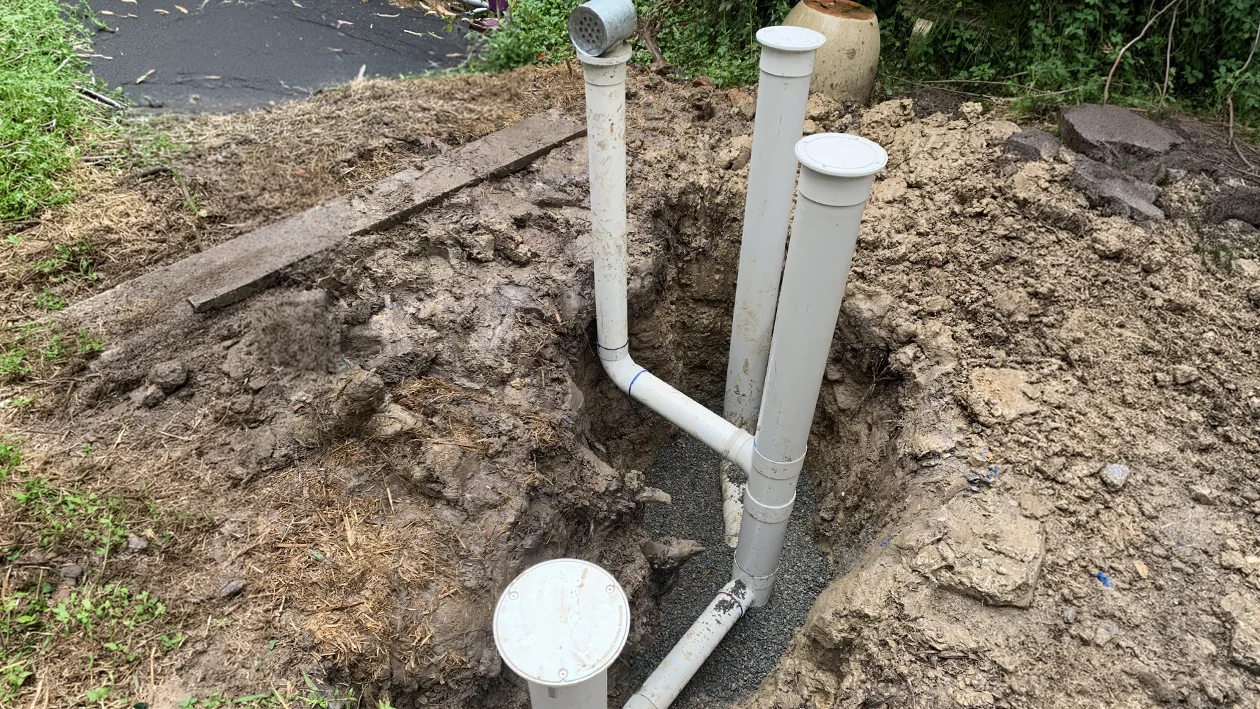
A boundary trap is a U-shaped bend in your sewer line, buried near where your pipes connect to the main, that holds a permanent plug of water. That water seal stops gas from the Sydney Water system getting into your pipes, while your wastewater still flows out to the main.
Not every Sydney home has one. Whether yours does depends on when your street was sewered and whether it sits in what Sydney Water calls a boundary trap area. The age of the house only tells you part of the story.
Is your boundary trap overflowing right now?
- Stop using water inside – toilets, showers, the washing machine and the dishwasher.
- Keep children and pets away and treat the overflow as raw sewage. Wash your hands after any contact.
- Don’t hose it back down the riser or gully. That just spreads it around.
- Take a few photos of the cap, the area around it and anything happening inside. Your insurer or plumber may ask for them.
- If it only overflows while you’re using water, or you’re not sure where the blockage is, call a licensed drainer from Ready Set Reline on 0422 704 670. If it’s overflowing with nothing running, or it’s coming out of a maintenance hole in the street, call Sydney Water on 13 20 90.
Once it stops, don’t assume it’s sorted. The blockage is still in the line, and the next load of washing can bring it straight back.
What Does a Boundary Trap Look Like, and Do You Have One?
You can answer this with three checks from above ground. None of them involve opening a pipe.
The three-point yard check
-
- Look for a capped riser near the boundary. The trap sits underground. What you’ll see is the top of the riser. A riser is a vertical shaft that brings the inlet side of the trap up to ground level so the drain can be inspected and cleaned. It’s either sealed with an airtight cap or finished as a ground vent. Older homes usually have a round metal lid, and newer work a PVC screw cap. Start on the side of the block where your sewer connects. That’s usually the front, but where the sewer main runs behind the houses it’ll be at the back.
- Look for a short vent pipe with a grille or flap nearby. Sydney Water calls this an induct pipe with mica flap: a plastic or metal pipe with air vents, near your sewer connection, that lets air into your wastewater pipes. Plumbers shorten it to IPMF. An IPMF sitting near a capped riser is a strong sign you’ve got a boundary trap.
- Check your sewer service diagram. Sydney Water sells sewer service diagrams for properties. Boundary traps have their own symbol, which looks like this:

The boundary trap symbol on a Sydney Water sewer service diagram Short of putting a camera down the line, it’s the most reliable way to confirm. If there’s no diagram for your property or you can’t make sense of it, call Sydney Water on 13 20 92 on weekdays.

What your results mean
Result A: a capped riser, a flap vent nearby, and a boundary trap on the diagram. You’ve got one. Your job is to keep the cap at ground level, sealed, and clear of garden beds and paving.
Result B: a single straight shaft with a cap, no flap vent, and no trap on the diagram. That’s most likely an inspection shaft. It’s an access point near your connection that a plumber uses to check or unblock the pipes, but it holds no water seal. Where there are no boundary traps, the street sewer is ventilated through the vents on household connections, so your house vents are doing that job.
Result C: nothing visible, but the diagram shows a trap. Either the riser has been buried, paved over or cut down, or the diagram isn’t quite right. Don’t start digging to find it. A licensed drainer can locate it and check for other underground services before any excavation.
Water sitting in the trap is normal. If the cap is off or a plumber opens it, you’ll see water down in the riser. That’s the water seal doing its job, not a blockage. The warning sign is water rising towards the top or coming out.
Action plan if something’s not right
- Cap missing or broken: cover the opening temporarily so soil and rain can’t get in, then have a licensed drainer fit a proper airtight cap. Sydney Water says you mustn’t let rainwater or stormwater into your wastewater system, and an open riser in a garden bed does exactly that. It’s the same reason downpipes must never run to the sewer, which we cover in our guide to blocked stormwater drains.
- Riser buried under pavers, turf or decking: have it raised back to finished ground level so it can be reached in a hurry.
Boundary trap or something else? Four fittings people mix up
Four fittings get confused in Sydney yards. The descriptions below follow the definitions in Sydney Water’s guide to sewer service diagram symbols.
| Fitting | What you’ll see | What it does | Holds a water seal? |
|---|---|---|---|
| Boundary trap | Capped riser near the boundary, trap underground | Stops gas from the main getting into your drains | Yes |
| Inspection shaft | Straight capped shaft near the connection | Access for a camera or jetter | No |
| Overflow relief gully (ORG) | Round grate at ground level, usually with a tap above it | Lets a blockage spill outside instead of inside | Yes |
| Induct pipe mica flap (IPMF) | Short pipe with vents near the trap | Lets fresh air into your house drain | No |
Boundary Trap Problems and How They Get Fixed
The usual problems are:
- a blockage sitting in the U-bend
- tree roots through old clay joints
- a riser that’s been damaged or buried
- a trap that has cracked or shifted in the ground
Every one of them is licensed work. If you’re already dealing with one, contact us today.
What you can and can’t do yourself in NSW
Plumbing and drainage work in NSW is regulated under the Plumbing and Drainage Act 2011, and only licensed contractors can carry it out. It isn’t a DIY job. That includes cutting into, replacing or re-routing any part of the sewer line, and the trap and riser are part of that line. You can look, take photos, keep the area clear and give your plumber good information.
Sydney Water also has a say. Removing a boundary trap needs an application to Sydney Water, which is only accepted under specific conditions. Pulling one out during a renovation because it’s in the way isn’t an option.
Who’s responsible for a boundary trap in Sydney?
You are. Plenty of guides online say the trap is the dividing line between you and Sydney Water, but Sydney Water’s own documents say otherwise. Property owners own every wastewater pipe and fitting up to where they meet Sydney Water’s system, including the point of connection, and that private line can run beyond the property boundary. Sydney Water owns the junction on its main. The owner is responsible for the connection to it, including clearing tree roots that get into the junction and any damage from roots or excavation.
The exception is a blockage in the main itself. That’s Sydney Water’s to fix. If sewage is coming out of a maintenance hole on public land, call them on 13 20 90 at any hour. If your plumber finds the blockage is in Sydney Water’s pipes and reports it, you can claim reasonable out-of-pocket costs back.
How a licensed drainer fixes a boundary trap
- Locate and confirm. Pull the sewer service diagram, find the riser, and check for other services before any digging.
- Clear the line. High-pressure drain cleaning through the riser shifts wipes, fat and root mass sitting in the bend.
- Put a camera through it. A CCTV drain inspection shows whether you’ve got a one-off blockage or a cracked, root-infested or displaced trap. If you clear the line without looking, the same blockage tends to come back.
- Pick the repair. If the pipe is sound, clearing may be all it needs. If roots are getting through the joints but the trap still holds its shape, relining is on the table. Brawoliner, the liner Ryan trained on at the factory in Germany, is built to go around bends of up to 90 degrees. A collapsed trap gets dug out. The straight runs either side can often be done with trenchless pipe relining instead. Our pipe relining cost guide explains how relining is priced.
- Test and finish at the surface. The new work is tested, the riser is brought back up to finished ground level, and the cap goes on airtight so the next person can find it and open it.
What makes a boundary trap repair bigger
Two boundary trap jobs can look the same on paper. Site conditions make the difference. These are the things that add time and work:
- Depth. The deeper the trap sits, the bigger the hole. Once a trench reaches 1.5 metres, safety rules require every side to be shored, benched or battered so it can’t cave in.
- What’s on top of it. Concrete, pavers, a driveway or a retaining wall all have to come up and go back down.
- Buildings close by. A trap near footings or a wall limits where and how far you can dig.
- Trees. Established roots around the trap slow the dig, and they usually mean the pipe either side needs a look too.
- Heritage surfaces. Sandstone paths and tessellated tiles take far more care to lift and relay than turf.
- Where your line runs. Your private line can run beyond the property boundary. Work between your boundary and the kerb needs council approval under section 138 of the Roads Act before anyone digs.
A camera inspection tells you which of these you’re dealing with. Get that before anyone quotes. If you’re weighing up a dig against a liner, pipe relining vs pipe replacement walks through the trade-offs.
Try this now
- Photograph your riser cap and measure where it sits from a fence corner or letterbox. It saves time when a drainer turns up.
- Find your overflow relief gully near the bathroom or laundry and lift the grate. It should come away freely. The ORG needs to sit at least 150mm below the lowest fixture inside, such as a floor waste, and 75mm above the finished ground. A garden bed built up around it stops it working.
- Tip a bucket of water down any shower or floor waste that doesn’t get used much.
- Note when smells or slow drains show up, such as after rain or after heavy use. That pattern helps pin down the cause.
- Order your sewer service diagram if you don’t have one.
Common mistakes
- Paving, decking or turfing over the riser cap
- Planting trees or large shrubs over the sewer line near the trap
- Replacing a lost cap with a brick, pot plant or loose lid that isn’t airtight
- Hosing an overflow back down the riser or gully
- Assuming a blocked boundary trap is Sydney Water’s problem to fix
- Removing the trap during a renovation without Sydney Water’s approval
Does a Boundary Trap Need a Vent?
Yes. The vent just isn’t on the trap itself. The water seal blocks air as well as gas. The drain on your side needs its own fresh air supply, and the sewer main needs another way to breathe.
On your side, air comes in through the IPMF near the trap, moves through your pipes and leaves through the vent pipes above your roof. Some homes also have an air admittance valve in a cupboard or ceiling space. It only lets air in.
On the street side, the trap stops the sewer main venting through your house. Sydney Water puts vent shafts on the main instead, commonly about every 400 metres. You’ve probably seen them.
Where the air gets in and out
| Vent | Where you’ll find it | Its job | Signs it’s not working |
|---|---|---|---|
| Induct pipe mica flap (IPMF) | Near the boundary trap, low to the ground | Lets fresh air into the house drain | Broken or missing flap, pipe snapped by a mower, smell at the vent |
| Vent pipe | Up an outside wall, finishing above the roof | Releases drain gas above head height | Smells indoors, gurgling drains |
| Air admittance valve | Cupboard or ceiling space | Lets air in, stays closed otherwise | Smell in the cupboard, slow draining nearby |
| Sydney Water vent shaft | Tall pole or wall-mounted pipe on public land | Ventilates the sewer main | Not yours to touch; report problems to Sydney Water |
The glug test
Fill a basin or bath, pull the plug and listen at that fixture and at nearby drains. A healthy drain goes quietly. Loud glugging, or gurgling from a different fixture, means air is being dragged through a trap because the pipework can’t get it from anywhere else. The cause is either a blocked or damaged vent, or a partial blockage choking the line. A camera will tell you which, and neither problem fixes itself.
Why Does Sydney Still Have Boundary Traps?
Sydney Water’s technical term for it is an inverted syphon trap: a dip in your drain that holds water so sewer gas can’t get through to the house. They’ve been around a long time.
Sydney Water’s Vent Shaft Guideline traces them back to the 1890s, when Sydney’s sewers carried industrial and domestic wastewater together with stormwater. When foul air started coming back into newly connected homes, Sydney Water’s predecessor, the Board, built vent shafts on the sewers and households fitted boundary traps. By the 1940s, common practice had moved to supplying sewers with fresh air through household connections without boundary traps. From 1953 the requirement generally stopped, apart from exceptions such as small extensions in areas that already had boundary traps. Existing traps stayed put.
Sydney Water now says many boundary trap areas got that label because of trade waste or poor ventilation, and neither is a problem any more. New developments in those areas may be able to go without a trap, but only with Sydney Water’s approval. That opens a door for developers. It doesn’t mean you can pull yours out.
Businesses still need them, though. Sydney Water’s installation requirements for grease traps say every commercial and industrial property with a gravity sewer connection, meaning waste drains to the main rather than being pumped, must have one. A business without one that applies for trade waste approval has to install one at the boundary or the point of connection. If you run a café, restaurant or workshop, the trap at your boundary is a compliance item as well as a drainage fitting.
The downside of an old boundary trap is where it sits. The U-bend is a low, slow point at the end of your line, so wipes and fat that shouldn’t be there tend to settle in it. On older properties the trap is often clay with joints that roots work their way into.
Is a boundary trap the same as the trap under your sink?
Same idea, bigger pipe. Each fixture in your home has its own trap, and the boundary trap guards the whole line at the property end.
Much of the online advice about “illegal S-traps” and trap distances in inches comes from American plumbing codes and doesn’t carry over. NSW regulators assess plumbing work against the Plumbing Code of Australia and the deemed-to-satisfy requirements of AS/NZS 3500. If you’re worried about a fixture trap, have a licensed plumber check it against those.
Troubleshooting: Warning Signs and Sewer Smells
A blockage at the boundary trap usually builds up over time. It gives warnings.
Early warning signs of a blocked boundary trap
Sydney Water lists these as signs of a wastewater blockage:
- Sinks, the bath or the toilet emptying slowly
- A toilet that isn’t flushing properly
- Gurgling from a toilet or floor drain
- Water overflowing from the gully near your outside tap
If any of these keep coming back, get the line checked before it overflows.
What smells and symptoms usually mean
Use this table to narrow down the cause before you call someone. It’s a starting point, not a diagnosis.
| What you notice | Likely cause | What to do |
|---|---|---|
| Sewer smell in the yard near the boundary | Missing or cracked riser cap, damaged IPMF, or a broken trap | Keep the area clear and get a drainer to inspect and recap |
| Smell from one rarely used shower or floor waste | The trap’s water seal has dried out | Tip a bucket of water down it; if the smell returns, get it checked |
| Smell through the house plus gurgling | Blocked or damaged vent, or trap seals being siphoned | Do the glug test, then book a camera inspection |
| Water rising around the riser cap or ORG grate | Blockage downstream | Follow the overflow steps at the top of this guide |
| Slow drains across the whole house | Blockage at or near the trap, often roots or wipes | Jetting followed by CCTV |
A dry trap is more than a smell problem. Hong Kong’s Department of Health investigated the 2003 SARS outbreak at the Amoy Gardens housing estate. It found most households mopped their bathroom floors instead of washing water down the drains, so the floor drain traps had likely dried out. In one flat, investigators showed air being drawn up from the building’s main drain pipe through the floor drain when the bathroom exhaust fan was switched on. Their most likely explanation was that those dry traps let contaminated sewage droplets into bathrooms.
An exhaust fan pulls air from wherever it can. In a Sydney ensuite or laundry, a dry floor waste is an open path to the drain. Tip a bucket of water down any floor waste that never gets used.
What a Healthy Boundary Trap Setup Looks Like
When everything is working, you’ll notice very little:
- Drains empty quietly, with no glugging.
- There’s no sewer smell inside or near the boundary.
- The riser cap sits at ground level, sealed and easy to find.
- The IPMF is intact, with its flap in place.
- The ORG grate lifts freely and sits clear of garden beds and paving.
- A camera inspection shows round, clean pipe, with water sitting only in the bend of the trap.
Boundary Trap Giving You Trouble?
We’re a local, owner-run team based in Roseville with 22+ years in the trade, working across the North Shore, Northern Beaches, Eastern Suburbs, Inner West and Hills District. You get a fixed upfront price before work starts. The price doesn’t move. Relined pipe carries our 50-year liner warranty and 100% workmanship guarantee, and we’ll beat any comparable written quote by 10%.
Call 0422 704 670 or get in touch online to book an inspection.