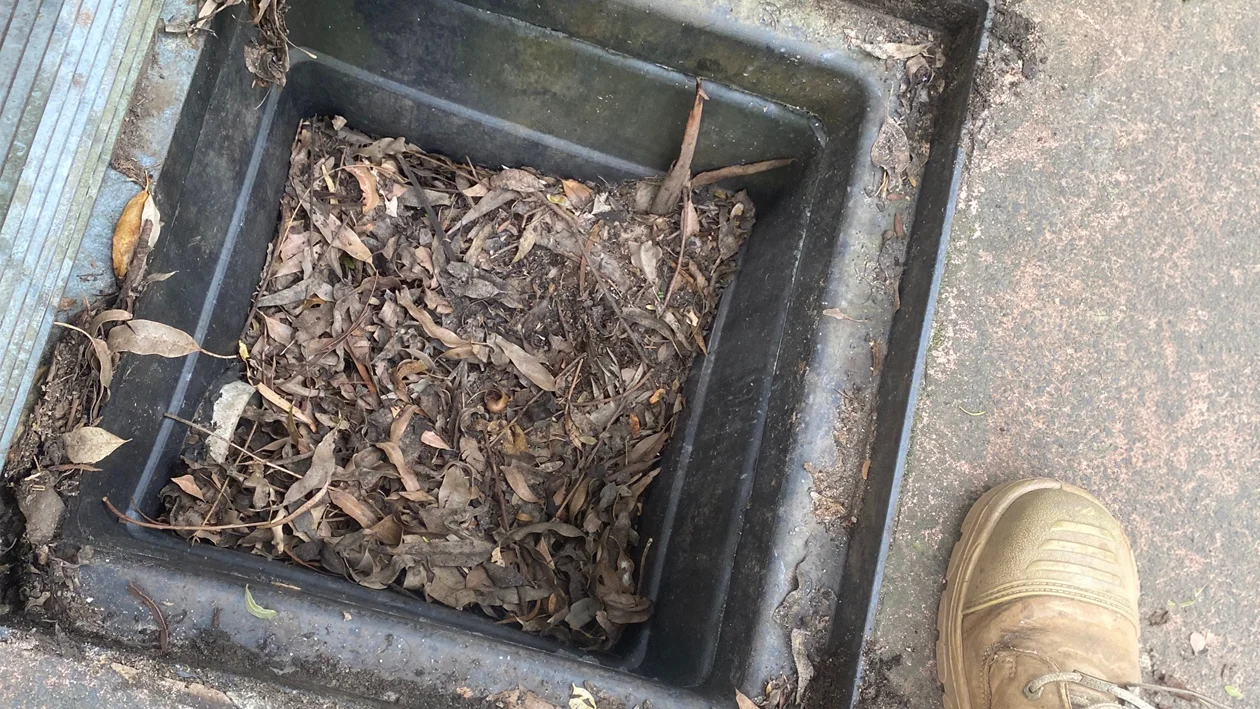
The best way to clear a blocked stormwater drain is to physically break up and remove what’s causing it, using a drain auger (a motorised plumber’s snake) or a high-pressure water jetter to cut through tree roots, silt and packed leaves. Chemicals won’t do it. Drain cleaners can’t dissolve mud or roots, and whatever you pour in ends up in the nearest creek or beach.
Most stormwater blockages sit close to the surface, and you can sort those yourself in under an hour. The ones that sit deeper in the line are a different job. The checklist below tells you which one you’re dealing with before you spend a Saturday on it.
What happens if a storm drain is clogged? (The 60-second blockage assessment)
Block a stormwater drain and the rain has nowhere to go. It pools around the grate, overflows gutters, backs up through downpipes and can end up against your house slab or under the floor. Left alone, that means damp walls, undermined paths and, in heavy rain, water through the back door. It gets worse every storm.
What causes a blocked stormwater drain?
Most blockages are leaves, silt and garden debris washed off the roof and yard. The rest come from tree roots getting in through cracked or open joints, a sagging or broken section of pipe catching debris, or a connection that was never done properly. Debris you can clear yourself. The other three need a camera to find.
The “surface vs deep line” assessment
Before you pull anything apart, work out whether the blockage is at the surface or down in the pipe.
- Shine a torch down the grate. Can you see leaves, mud or sticks sitting in the pit? That’s a surface blockage, and it’s a DIY job.
- Watch what happens after light rain. If water pools around the grate but the pit itself isn’t full, the grate or the top of the pit is choked. Also a DIY job.
- Check your downpipes. If water is backing up out of the downpipes while the gutters and the pit look clear, the blockage is further down the pipe. That’s a job for a drain auger or jetter. Many Sydney homes have charged lines, where downpipes run underground and push water up and out at a pit or the kerb. If one of those blocks, the water backs up the downpipe instead.
What to do next:
- Surface blockage: go straight to the four-step clearing protocol in the next section.
- Deep pipe blockage: skip ahead to “What do plumbers use instead of Drano on stormwater drains?” to see what it takes to shift it.
Do this now: grab a torch and a flathead screwdriver (to lever up the grate) and run through the three checks. It takes about a minute.
If the grate won’t lift: tap around the edges with a rubber mallet to break the seal of rust and dirt, then lever it up again. Grates on larger pits are heavy. Lift with your legs and keep your fingers clear of the edges.
What is the best way to clear a blocked stormwater drain?
Whether you call it a stormwater drain or a rainwater drain, the most effective DIY way to unblock it is manual removal. Use your hands, a wet and dry vacuum and a drain rod to get the debris out of the pit and the first few metres of pipe. You’re not trying to dissolve anything. You’re trying to pull it out.
The 4-step physical clearing protocol
Step 1: Remove the grate and dig out the pit.
Put on heavy-duty gloves. Lift the grate and scoop out every bit of mud, leaves and gravel you can reach. Leaves can go in the green bin. Mud and gravel go in general waste, not back in the garden where the next storm will wash it straight back in.
Step 2: Vacuum out the pipe mouth.
Push the hose of a wet and dry vacuum into the pipe outlet at the bottom of the pit. Wrap a wet rag around the hose where it meets the pipe to get a seal. Then run the vac. This pulls out the fine silt that settles just inside the pipe and that you can’t reach by hand.
Step 3: Rod the line.
Feed a flexible drain rod or manual snake into the pipe. When you hit resistance, turn it clockwise. Keep pushing gently. The turning action breaks up packed dirt and leaf matter so it can wash through. If the rod won’t get through within the first few metres, stop. Pushing harder packs the blockage further down the line, and that’s a job for a jetter.
Step 4: Run the flush test.
Put a garden hose into the pit and run it at full flow for three minutes.
What you’ll need:
| Item | What it’s for |
|---|---|
| Heavy-duty rubber gloves | Handling mud, sharp debris and whatever’s living in the pit |
| Wet and dry vacuum | Pulling silt out of the pipe mouth |
| Manual drain snake, around 15m | Breaking up blockages past arm’s reach |
| Flathead screwdriver and rubber mallet | Freeing and lifting the grate |
| Garden hose | The flush test |
How to know it’s fixed: the 3-minute hose test. If water runs away for three continuous minutes without the level rising in the pit, the line is clear. If it climbs, you’re not done.
The most common mistake: turning the drain rod anticlockwise. Rod sections screw together, and turning them the wrong way unscrews the joints. You pull the handle out and leave the business end stuck in your drain, which turns a free fix into a call-out. Always turn clockwise.
How to stop it blocking again
Keep the gutters clear, especially before storm season. Fit a leaf basket or finer grate to pits under trees. Sweep grass clippings and leaves up rather than blowing them towards the pit. If it blocks twice in a year, get a camera down it, because something in the pipe is catching debris.
What’s the strongest chemical to unclog a stormwater drain? (And why you shouldn’t use it)
Nothing you pour down a stormwater drain will unblock it. Boiling water, bicarb and vinegar, salt and dishwashing liquid all fail for the same reason: none of them can shift leaves, silt or roots. The strongest drain cleaners contain sulfuric acid or sodium hydroxide (caustic soda). Don’t put either down a stormwater drain. They can’t break down mud, leaves or roots, and stormwater isn’t treated, so every drop goes straight into the local waterway.
What’s in the pit tells you why chemicals won’t work. Australian research on what washes into stormwater drains found about 80 per cent of it is organic material like leaves and twigs, with litter making up the rest. On residential streets, it’s mostly leaves from street trees and grass clippings. Most of the litter doesn’t float, either. It sinks or gets dragged along in the flow, and that’s why we find it packed down at the bottom of the pit and into the first stretch of pipe.
Most of the home remedies you’ll find online don’t do any better. Here’s how they stack up against a typical stormwater blockage.
Drain unblocker efficacy and safety matrix
| Method | What it actually does | On a stormwater blockage | Verdict |
|---|---|---|---|
| Boiling water | Can soften PVC pipe and loosen glued joints | Does nothing to mud or roots | Don’t use |
| Bicarb soda and vinegar | Fizzes, then leaves mostly water and a mild salt solution | Can’t shift silt, leaves or roots | Ineffective |
| Salt poured in nightly | Myth based on salt killing roots | Corrodes metal fittings and harms soil and waterways | Harmful |
| Dishwashing liquid | Breaks down grease in kitchen sinks | Useless against leaves and mud | Ineffective |
| Acid or caustic drain cleaner | Dissolves hair, grease and soap scum | Won’t touch outdoor debris, pollutes waterways | Don’t use |
What do plumbers use instead of Drano on stormwater drains?
For stormwater, we go mechanical, not chemical. The three tools that do the heavy lifting are:
- CCTV drain camera. A waterproof camera on a cable goes down the line so we can see exactly what’s blocking it, where it is and whether the pipe itself is damaged. No guessing, no digging to find out. See our CCTV drain inspection page for how that works.
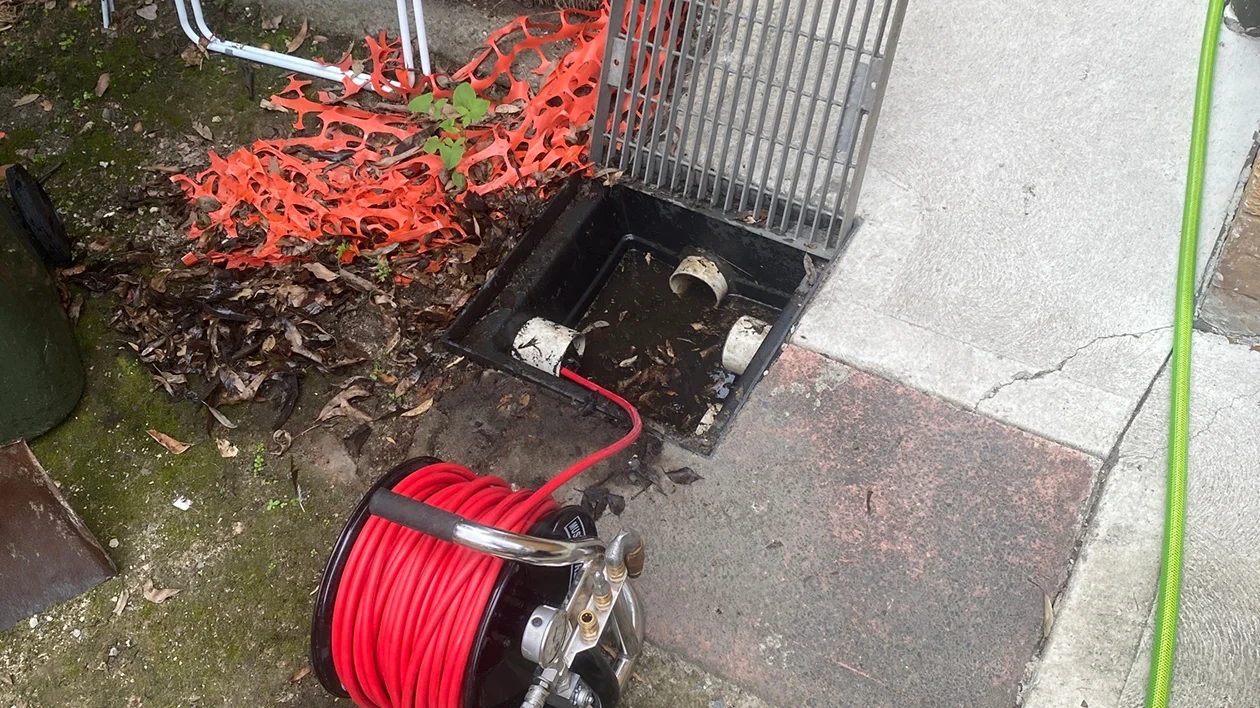
- High-pressure water jetter. A hose with a specialised nozzle blasts water at high pressure to cut through packed silt, grease and roots, then flushes the debris down the line.
- Motorised drain auger. A powered cable with a cutting head that chews through blockages a hand rod can’t budge.
When it’s time to call a plumber. Call us if the rod won’t get through, water is still backing out of the downpipes after you’ve cleared the pit, water is getting under the house, or the same drain blocks again within a few months. A repeat blockage usually means something in the pipe is holding debris back. For a blockage you can’t shift yourself, our drain cleaning page covers what’s involved.
If roots keep coming back after the line’s been cleared, the pipe has a crack or a failed joint that they’re getting in through. Clearing it again only buys you time. Fixing the pipe with trenchless pipe relining seals the entry point so they can’t get back in.
Do this now: if you’ve got chemical drain cleaner in the shed for outdoor use, get rid of it through your council’s household chemical collection. Don’t tip it down the sink or the drain to empty the bottle.
Which approach fits your blockage?
- Grease, hair or soap build-up inside the house? That’s an indoor issue. An enzyme drain cleaner is a reasonable first step.
- Leaves, mud or roots in an outdoor drain? Physical removal first. If that fails, it’s a jetter or auger job.
Can I dump soapy water down a storm drain? (Storm drains vs sewers)
No. In Sydney, stormwater and sewer are two completely separate systems. Sewage goes to a treatment plant. Stormwater doesn’t. Whatever goes into a stormwater pit, kerb gutter or street drain flows untreated into local creeks, rivers, the harbour and the beaches.
Keeping the two apart matters both ways. Sydney Water designs its sewer pipes to carry around three times normal dry weather flow. In heavy rain, stormwater getting in through cracked pipes and wrong connections can push that to five to ten times. A common culprit is a downpipe or pool drain plumbed into the sewer instead of the stormwater. When the sewer overloads, it’s built to overflow into creeks and stormwater drains, because the alternative is sewage coming up through toilets and backyard gully traps (the grated drain outside, usually near the laundry).
Putting anything other than rainwater into the stormwater system is an offence in NSW. Under the Protection of the Environment Operations Act 1997, councils and the NSW EPA can fine people for polluting stormwater, and that includes soapy water, paint and oil.
What should you never pour down your stormwater drain?
- Car wash runoff and other soapy water
- Paint, including water-based paint and brush-washing water
- Motor oil and other automotive fluids
- Chlorinated pool water (backwash goes to sewer, not stormwater)
- Harsh cleaning chemicals of any kind
Key takeaway: washing the car at home? Park it on the lawn. The grass and soil soak up and filter the soapy water instead of letting it run down the driveway into the kerb and out to the nearest creek.
Next step: your washing machine, laundry tub and any outdoor sink should drain to the sewer, never to stormwater. And your downpipes and pool drains should go to stormwater, never the sewer. If you suspect something is connected to the wrong system, get a licensed plumber to check it. Rerouting drainage is licensed work in NSW. Getting it fixed properly now saves a headache if it’s picked up when you sell.
Who’s responsible for a blocked stormwater drain?
If the pipe is on your property or connects to it, it’s yours to fix, including pipes you share with a neighbour. The City of Sydney is clear on this, and councils can order an owner to repair a broken stormwater pipe. Street pits and kerb drains belong to council, so report those to them.
Stormwater drain still blocked? We’ll find out why
If the pit’s clear and the water’s still backing up, the problem is further down the line. We’ll jet it clear, put a camera down to show you what caused it, and give you a fixed price before any work starts. The CCTV inspection and quote are free, and we can usually get to you the same day.
Call Ready Set Reline on 0422 704 670 or send us a message.