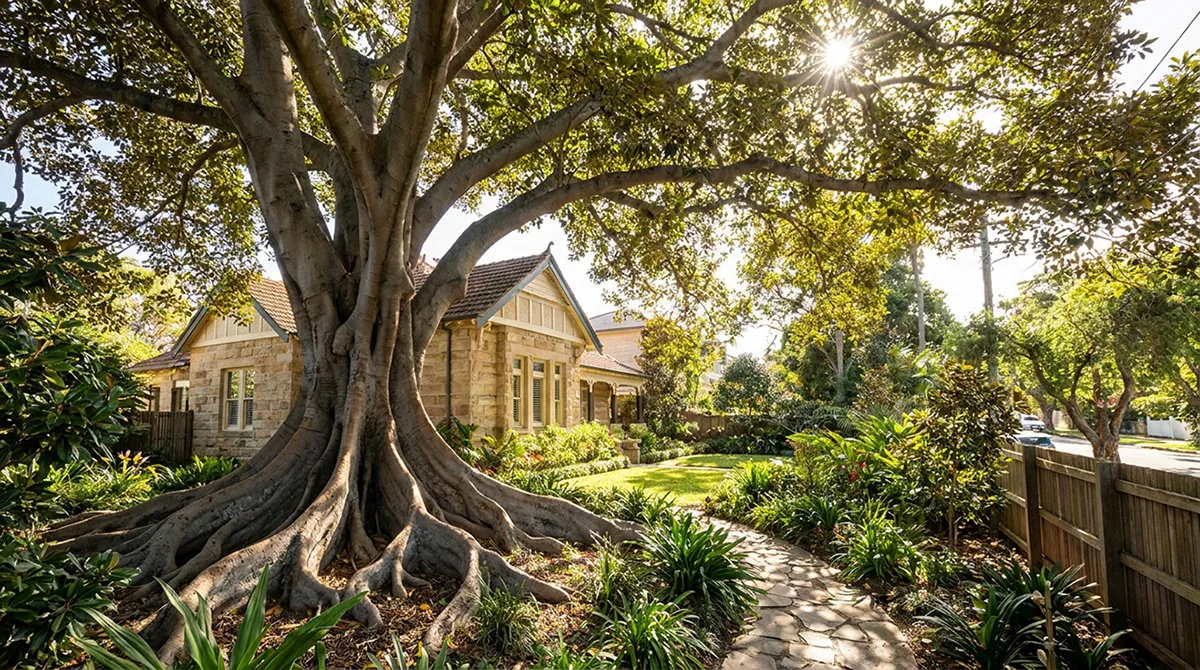
Trees with invasive roots are species whose root systems spread wide and fast in search of water. Roots go where the water is. That’s what gets them into sewer pipes, stormwater lines and footings. Around Australian homes, the worst offenders are fig trees (Ficus), weeping willows, poplars, jacarandas, camphor laurels and liquidambars. If you want a tree close to the house, choose one with a compact, non-aggressive root system, such as a lilly pilly, tuckeroo or lemon myrtle.
Roots rarely break a sound pipe on their own. They find an existing crack or a gap at a joint where moist air and water are leaking out. Then they grow inside, fill the pipe and push the crack wider. Big tree, old clay pipe, that’s trouble.
What Trees Have Invasive Roots in Australia?
The trees with the most invasive roots in Australia are figs, willows, poplars and camphor laurels, followed closely by gum trees, jacarandas, liquidambars and the Illawarra flame tree. Their roots spread well past the canopy looking for water and get into sewer pipes through cracks and loose joints. Once inside, they cause blockages, and over time they can lift slabs, paths and driveways.
What the Sydney data shows
A five-year Sydney study by researchers B.P. Wilkins and R.J. Turner looked at 460 drain blockages caused by tree roots. Five trees were behind just over half of them: figs (15.9%), eucalypts (12.2%), willows (11.3%), liquidambars (6.3%) and jacarandas (6.1%). In some cases, fig roots blocked a drain around 27 metres from the trunk. The study also found more blockages in autumn and winter than in the warmer months, so a slow drain in June is worth taking seriously. (Source)
Trees to keep away from the house
The NSW Water Directorate, the peak body for council-run water utilities in regional NSW, rates common trees by how likely they are to block sewers and damage pipes. Here’s how the usual suspects score. (Source)
- Fig trees (Ficus): Extreme. The most common culprit in the Sydney blockage study.
- Weeping willow: Extreme. Yes, willow roots are among the most invasive. They spread far beyond the canopy and head straight for water, which makes a leaking sewer joint an easy target.
- Camphor laurel: Extreme. A big, fast-growing tree that NSW DPI treats as an invasive weed, particularly on the north and mid north coast.
- Poplars (Populus): Extreme. Fast-growing and water-hungry, and behind 4.6% of the blockages in the Sydney study.
- Large gum trees (Eucalyptus): Very High. The second most common culprit in the Sydney study. Fine on a big block, wrong for a suburban backyard near the sewer line.
- Jacaranda: Very High. Beautiful purple flowers, aggressive water-seeking roots.
- Illawarra flame tree: Very High. A native favourite that still rates as a serious risk to pipes.
- Liquidambar: Very High. A popular autumn shade tree with surface roots that lift driveways and paths.
The short version: native doesn’t automatically mean safe. Check how a tree’s roots behave before you buy it.
How Do You Kill an Invasive Tree’s Roots?
The fastest way to kill an invasive tree’s roots is to cut the tree or root and immediately paint a systemic herbicide containing triclopyr or glyphosate onto the fresh cut. The plant draws the chemical down into the root network and kills it from the inside. Small trees usually die back within a few weeks. Big ones take longer. Willows and liquidambars also shoot new growth up from the roots, so expect to treat them twice.
Before you start: most Sydney councils need you to get approval before removing or poisoning a tree above a certain size, and the rules vary from council to council. Check with your council first. In 2025, Canterbury-Bankstown Council took a developer to court for removing trees without consent, and the fine came to $36,000.
The root kill method, step by step
- Make a fresh cut. Cut the stump horizontally, or expose the problem root and cut through it. Apply the herbicide straight away. A tree starts sealing a cut within moments, and once the sap seals over, the chemical won’t get in.
- Paint the outer ring. Use a paintbrush to apply a triclopyr-based tree and blackberry killer to the outer ring of the cut, the living layer just inside the bark. Mix it at the cut-stump rate on the label. Some products go on neat and others need diluting, so don’t guess.
- Drill and fill large stumps. Drill holes around the outside of the stump about 5cm apart, angled downwards into the living layer just inside the bark. Fill each hole with herbicide as soon as you’ve drilled it.
- Leave it alone. Don’t grind or pull the stump for at least three to four weeks. The chemical needs time to travel to the root tips. Watch for suckers coming up from the roots and treat those the same way.
Wear gloves and eye protection, and keep the herbicide off surrounding plants. Trees of the same species growing close together can share root connections, so poisoning one can sometimes affect its neighbour.
Roots in your sewer right now?
Poisoning the tree won’t clear roots that are already inside the pipe. Dead roots stay put and keep blocking it until they’re physically removed. High-pressure drain jetting clears them out. Here’s how we get tree roots out of pipes for good. Foaming root killers you flush down the toilet can slow regrowth for a while, but they don’t fix the crack the roots came in through, so the roots come back. If you use one, follow the label to the letter, and never pour root killer into a stormwater drain. Stormwater isn’t treated. It flows straight into creeks, rivers and the ocean.
What to expect after treatment
- First week or two: leaves yellow, wilt and start browning.
- Weeks two to four: bark begins to loosen and small surface roots turn brittle.
- After a month or more: a small tree’s roots are usually dead enough to dig or grind out. A large tree can take a full season.
Is it okay to leave tree roots in the ground?
Yes, once the tree is dead. The roots break down over several years and add organic matter to the soil. As they rot, though, the soil above them can settle, so expect some sinking over large roots. Don’t build or lay pavers over the area without grinding the main roots out first.
Roots that are already inside a pipe are a different story. They won’t rot away fast enough to stop blocking it, so have them cleared.
How Close Is Too Close to a House for a Tree?
As a rule of thumb, plant a tree at least half its mature height away from your house, footings and sewer line. Closer than that, and the roots are likely to reach the slab and the pipes as the tree grows. Roots don’t stop at the drip line.
The half-height rule
Expected mature height ÷ 2 = minimum safe distance from foundations and pipes
Example: a tuckeroo grows to around 8 metres. 8 ÷ 2 = 4 metres away from your slab.
| Distance from house or pipes | Risk | What suits it |
|---|---|---|
| Under 2 metres | High | Small shrubs with fibrous roots, such as feijoa |
| 2 to 4 metres | Moderate | Small natives like lemon myrtle or narrow lilly pilly varieties |
| 5 metres or more | Lower | Larger shade trees with non-invasive roots |
This rule assumes a species with well-behaved roots. The invasive trees listed above need far more room than this, and most don’t belong in a suburban backyard at all.
Measure from the sewer line too. If you’re not sure where your pipes run, you can order a wastewater service diagram for your property through Sydney Water Tap in.
Already planted too close?
A root barrier, a vertical sheet of tough plastic buried between the tree and your pipes, can steer roots down and away. It works best installed at planting time. Ask your landscaper what depth suits the species.
Warning signs to check today
If a tree fails the half-height rule, look for these three signs:
- Toilets that drain slowly or gurgle
- Vertical cracks in brickwork near the tree
- Pavers lifting around the base of the tree
Cracks in brickwork can also come from clay soil that swells when it’s wet and shrinks when it dries, which is common across Sydney. One sign on its own doesn’t prove the tree is to blame.
What to do next
If you’re seeing those signs, book a high-pressure drain clean and CCTV inspection before you call the arborist. The camera shows whether roots are actually in the pipe, exactly where they’re getting in and how bad the damage is. Sometimes it’s the neighbour’s tree, not yours.
If roots are in the line, the fix is usually to jet them out and then reline the pipe. A relined pipe has no joints or cracks for roots to get back into, so in many cases the tree can stay.
What Are the Best Screening Trees to Plant Near a House in Australia?
The best screening trees with non-invasive roots in Australia are the lilly pilly (try ‘Straight and Narrow’), the tuckeroo and the lemon myrtle. All three are natives that give you privacy without threatening your plumbing.
Privacy tree comparison
| Lilly pilly ‘Straight and Narrow’ (Syzygium) | Tuckeroo (Cupaniopsis) | Lemon myrtle (Backhousia) | |
|---|---|---|---|
| Root type | Fibrous, compact | Non-invasive | Non-aggressive |
| Mature height | 5 to 8m, only 1 to 1.5m wide (can be hedged) | 5 to 8m in most gardens, up to 12m as a street tree (rounded canopy) | Around 5m in gardens (dense canopy) |
| Growth speed | Fast | Moderate | Slow |
| Best for | Blocking out two-storey neighbours in tight spaces | Coastal properties and salt air | Small gardens, fragrance near windows |
Which one should you choose?
- Screening a strip only 1 metre wide? Lilly pilly ‘Straight and Narrow’.
- A shade tree near the pool? Tuckeroo.
- Fragrant flowers near a bedroom window? Lemon myrtle.
Buying bamboo for screening? Ask the nursery specifically for clumping bamboo, such as Bambusa textilis. Never buy running bamboo (Phyllostachys). It spreads underground well beyond where you planted it and is very hard to get rid of.
If you’ve got a big tree near your sewer line and the toilet has started gurgling, get a camera down the line before anyone fires up the chainsaw. Book a CCTV drain inspection. Then you’ll know.