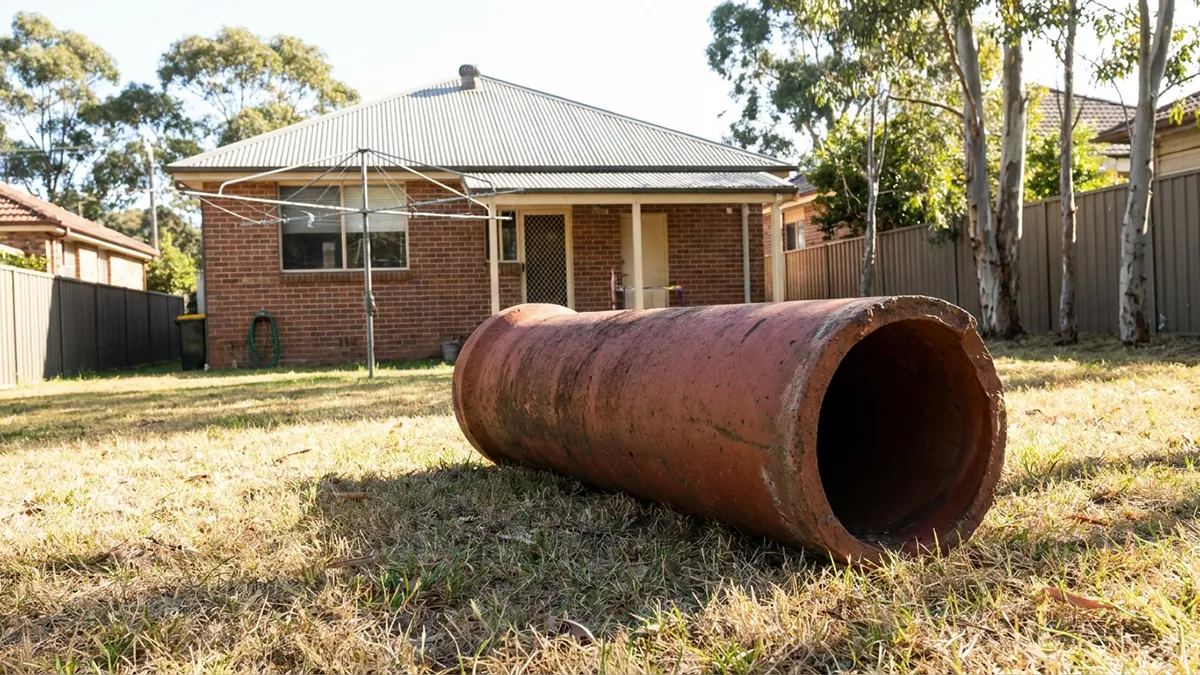
A clay sewer pipe, also called a vitrified clay pipe (VCP) or earthenware pipe, is a kiln-fired ceramic pipe that was the standard sewer line in Sydney homes for most of the 20th century. The clay itself can last 100 years. The weak point is the joints between each short section, where tree roots get in, the ground moves and the line cracks.
If your house was built before the 1980s and the sewer line has never been replaced, it’s probably clay. That isn’t automatically bad news. Plenty of clay lines around Sydney are still working fine. Others are full of roots and close to collapse, and from inside the house the two can look the same.
What the old clay pipe is called
You’ll hear a few names, and in Sydney plumbing they all mean the same thing:
- Vitrified clay pipe (VCP): The technical term, and the one you’ll usually see in plumbers’ reports and CCTV inspection notes.
- Earthenware pipe: The everyday Australian name. It’s what an older plumber will call it, and often what’s written on a sewer service diagram.
- Terracotta pipe: Named for the reddish-brown colour. Glazed versions are darker and shinier.
Is earthenware pipe the same as clay pipe?
On a Sydney house sewer, yes. “Earthenware pipe” is just the older Australian name for the same glazed clay pipe. Strictly speaking, potters use “earthenware” for clay fired at a lower temperature, which stays slightly porous. Sewer pipe was fired much hotter, until the clay turned glass-like and watertight. That’s what “vitrified” means. So the earthenware sewer line on your diagram is a vitrified clay pipe, and everything on this page applies to it.
What size are clay sewer pipes?
Most Sydney house sewers are 100mm. Larger buildings and apartment blocks often run 150mm. Clay walls are thick, so a 100mm clay pipe is noticeably bigger on the outside than 100mm PVC, which matters when the two are joined.
How Long Will a Clay Sewer Pipe Last Under a Sydney Home?
Clay doesn’t rust or corrode. Sewer gas and household chemicals don’t eat into it the way they eat into cast iron. That’s where the figure of 50 to 100 years or more comes from. In practice, a house’s clay sewer line usually starts having trouble somewhere around the 50 to 60 year mark. The pipe itself is still sound at that age. It’s the joints that have started to go.
A few checks and a simple risk score will give you a fair idea of where your line sits.
Part A: Working out the age of your clay pipe
1. Find out when the house was built. Sale history, council records or the original building plans will tell you. Sydney homes built before the late 1970s almost always had earthenware sewer lines put in. PVC took over through the 1980s.
2. Get your sewer service diagram. Sydney Water holds a diagram for most connected properties. It shows where your private line runs and where it joins the main. Older diagrams often carry a date and a note about the pipe material. In a lot of Sydney suburbs the main doesn’t run under the street. It runs through the backyard, or the neighbour’s. The diagram shows you which.
3. Look at the joints. Your plumber may be able to see an exposed joint at an inspection opening (the capped pipe poking out of the ground in your yard), or your CCTV footage may show the joints clearly. Either way, the joint type tells you a lot:
- Older mortar (cement) joints: Rigid and brittle, and they crumble with age. Roots get through these more easily than any other kind.
- Rubber ring joints: These came in later and handle ground movement better, but they’re not root-proof. A Melbourne field study found clay pipe with rubber ring joints was common in the root blockages it looked at.
4. Count the joints on the camera footage. Older clay lines were laid in short lengths, so you’ll see a joint every metre or less. Later clay pipe came in longer sections. More joints means more places for roots to get in.
Who’s responsible for a clay sewer line in Sydney?
You are, from the house to where your line joins Sydney Water’s junction, including the joint at the junction itself. Sydney Water owns the main and the body of the junction (Sydney Water, Claiming wastewater blockages). If your private line has collapsed under a public road or footpath, Sydney Water may be able to help through its Collapsed Private Service in Public Land program.
Signs your clay sewer pipe is failing
The usual signs of a failing clay sewer line are:
- drains that block again in the same spot every few months
- gurgling when other fixtures drain
- a sewage smell in the yard
- a wet or unusually green patch along the line.
If you’ve had two or more of these, get a camera down it.
Part B: Your clay pipe risk score
Give yourself one point for each statement that’s true:
- The house was built before the 1980s and you have no record of the sewer line ever being replaced.
- There’s a tree over about 4 metres tall within 6 metres of where the sewer line runs. Gums and paperbarks showed up most in a Melbourne study. Figs, willows and liquidambars are also known for getting into pipes.
- More than one fixture drains slowly a few times a year, or the shower gurgles when the toilet flushes.
- There’s a patch of unusually lush green grass along the line, or the ground has sunk somewhere along it.
- The property is on reactive clay soil, sandy soil or filled ground, or there’s been heavy construction or excavation nearby.
- You’ve needed a plumber to clear the main line more than once in the last two years.
What your score means
0 to 1 points: Low risk. Your line is probably in reasonable shape for now. The point of a check is to get a baseline you can compare against later.
2 to 3 points: Moderate risk. Roots are probably already working into one or more joints, or a section has started to drop out of line. Left alone, it gets worse. Small cracks open up and partial blockages become full ones.
4 to 6 points: High risk. Expect cracked pipe, heavy root growth or a sagging (bellied) section where water sits. There’s a real chance of sewage backing up into the house.
What to do at each level
- Low risk: Book a CCTV drain inspection and keep the footage. Next time you can compare the two and see what’s changed.
- Moderate risk: Get a CCTV inspection and a high-pressure jet clean done together. Ask for footage with distance markers on screen, so every crack, root entry and offset is located by its distance from the inspection opening.
- High risk: Stop pouring chemical drain cleaners down. They won’t shift roots, and they can attack what’s left of the joint seals. Get the line inspected, then get itemised written quotes that compare a spot repair, relining and full replacement.
Things you can do today
- Walk the line with your sewer service diagram, from where it leaves the house to where it meets the main. Count the trees over about 4 metres tall within 6 metres of it.
- Check your property records and purchase paperwork for any sign the sewer line has been replaced.
- When you book an inspection, ask whether the camera has a locator. A locator lets the plumber mark the exact spot and depth of a problem from above ground, so nobody digs in the wrong place.
How Does Clay Compare With Other Pipes Found in Older Sydney Homes?
Clay isn’t the worst pipe you can have. In older Sydney homes the bigger worries are asbestos cement, because of the handling risk, and galvanised steel water pipe, which rusts from the inside out. Clay sits in the middle with cast iron. The material holds up, but the joints and the way it was laid let it down.
Common pipe materials in older Sydney homes
| Pipe material | Where you’ll find it | Main way it fails | Risk level | What usually happens |
|---|---|---|---|---|
| Asbestos cement | Some older sewer and stormwater lines | Goes brittle and cracks; can’t be cut or broken out safely without asbestos controls | High | Left in place and relined, or removed under asbestos rules |
| Galvanised steel | Older water supply lines | Rusts inside, narrowing the pipe and cutting water pressure | High | Replaced with copper or flexible plastic (PEX) pipe |
| Cast iron | Stacks, under-slab drains, older apartment blocks | Rusts along the bottom of the pipe; scale builds up | Moderate to high | CCTV inspection, then descaling and relining, or replacement |
| Vitrified clay (earthenware) | Most pre-1980s house sewer lines | Roots in the joints, cracking, joints moving out of line | Moderate | CCTV inspection, then a clean and spot repair if the damage is isolated, or relining or replacement if it’s widespread |
| PVC | Most homes built since the 1980s | Usually only fails if it was bedded badly or laid without enough fall | Low | The current standard |
Choosing what to do with your clay line
One or two bad joints, with the rest of the line straight and true: A spot repair. Either the plumber digs down, cuts out the damaged section and joins in PVC, or a patch liner goes through just that section. The rest of the clay line stays in service.
Can clay sewer pipes be relined?
Yes. As long as the pipe is still holding its shape and isn’t badly sagging, a clay sewer line can be relined. The line is cleaned out first, then a resin liner is cured inside it, sealing every joint along the way. A collapsed or bellied section needs digging up first.
Roots and hairline cracks at several joints, but no collapse or sag: Trenchless pipe relining. A new resin liner is cured inside the old pipe and seals every joint along the way, without digging up the yard, driveway or garden. No trench needed. Across the Sydney market, relining generally runs $400 to $1,100 per metre, with most complete residential jobs between $3,000 and $20,000. Our rate card covers clay pipe relining and replacement costs.
A collapsed, badly offset or sagging line: Replacement is usually the answer, either by open trench or by pipe bursting, where a new pipe is pulled through and splits the old one apart as it goes. A liner follows the shape of the pipe it sits in. If the pipe sags, so does the liner, and a liner can’t get through a section that has caved in.
Decision guide: what should you do with your clay sewer pipe?
- Has the line had a CCTV inspection in the last 12 months?
- No: Get one before you approve any repair.
- Yes: Go to question 2.
- Is the pipe collapsed, offset by more than about 25mm, or sagging enough to hold water?
- Yes: Go to question 3.
- No: Go to question 4.
- Is the damage confined to one spot, a few metres long, with reasonable access to dig?
- Yes: Spot excavation and repair.
- No: Full replacement, by open trench or pipe bursting.
- Are roots getting in at three or more joints, or are there cracks running along the pipe?
- Yes: Jet clean, then reline.
- No: Get it jet cleaned every couple of years and keep an eye on it.
Before you sign a quote
If a plumber clears your drain and quotes a full replacement on the spot without showing you any footage, ask for the CCTV recording with the distance readings visible on screen. A single offset joint and a line failing end to end need very different fixes. See the footage first.
Why Did Sydney Builders Stop Using Clay Sewer Pipes?
Builders moved away from clay for house sewer lines through the late 1970s and 1980s. Clay is heavy, comes in short lengths and cracks when the ground moves. All those mortar joints let roots straight in. PVC fixed both problems.
Clay was also used for stormwater lines, which carry rainwater, not sewage. They fail the same way, but a stormwater problem is a different job with different rules.
Why clay was used in the first place
For a long time nothing beat clay for chemical resistance. Fired clay isn’t affected by the hydrogen sulphide gas that builds up in sewers, or by the cleaning products that go down household drains, both of which slowly eat away at cast iron and concrete. Clay made sense back then.
Four reasons it fell out of use for houses
More joints. A typical Sydney house sewer runs 10 to 30 metres. Laid in short clay sections, that’s dozens of joints, and every one is somewhere a root can get in. The same run in PVC has only a handful.
It doesn’t flex. Clay is strong when it’s evenly supported. But it doesn’t bend. Reactive clay soils that shrink and swell with the seasons, roots pushing from the side, and cars or trucks driving over a shallow line can all crack it.
Roots find the joints. Old joints leak a little moisture and vapour, and tree roots follow it to the gap. A Sydney arborist’s analysis put numbers on what happens next (Hartley, Tree Root Damage to Pipes, 2012). Roots push with roughly 800 to 900 kPa. A 100mm clay pipe can carry around 34 kN per metre before it crushes, about 40 times more than a root lying alongside it can apply. Roots rarely break a sound pipe. They find a joint or crack that’s already open, push in and keep thickening until the pipe blocks or the joint gives way. There’s more on how roots get in and how they’re cleared in our guide to tree roots in sewer pipes.
It’s slower and harder to lay. Clay pipe is much heavier than PVC to handle, and it needs careful bedding to sit properly. PVC brought the time and labour cost down a long way.
Is clay pipe still used anywhere?
Yes. A lot of older council and water authority sewer mains are still clay. For new house sewer lines, though, PVC has been the standard for decades.
What this means for you
Having a clay sewer line isn’t a defect in itself. The pipe wall doesn’t rust, so a well-laid clay line away from big trees can outlast cast iron. What actually goes wrong is the joints opening up and roots getting in.
Four habits worth keeping if you’re holding onto your clay line
Keep heavy loads off it. House sewer lines are often quite shallow. Don’t park skip bins, trailers, caravans or delivery trucks on grass or garden above the line.
Book cleans for late winter and early spring. Root blockages tend to peak in late winter and early spring. In the Melbourne study, blockages were most frequent from August to October (Pohls, Bailey and May, Acta Horticulturae 643, 2004). Got a history of roots? Book the clean for the end of winter.
Don’t rely on a root treatment alone. The same study found several treatments slowed root growth, including copper sulphate, dichlobenil, slaked lime and cement slurry. None of them fixes the open joint the roots came through. Talk to your plumber about which treatment suits your line, and treat it as a way to buy time rather than a fix.
Don’t let anyone run a cutting head blind. Pushing an oversized cutter through brittle clay with offset joints can catch on the lip of a joint and break the pipe. Cleaning should be guided by a camera.
Can You Still Buy Clay Sewer Pipe in Sydney?
You can, but you won’t need it. New vitrified clay pipe mostly goes to civil and council projects through specialist suppliers. Bunnings and the everyday plumbing suppliers don’t carry it. When a damaged clay section is repaired, the usual approach is to cut it out and join in PVC with a coupling made for the clay-to-PVC transition.
Where clay pipe comes from now
- Civil and drainage suppliers: For council, heritage or commercial work where the specification calls for clay.
- Plumbing suppliers: These don’t usually stock clay pipe, but they do carry the clay-to-PVC couplings and adaptors a repair needs.
- Salvage and demolition yards: Fine for garden drainage or landscaping. Never use second-hand clay pipe in a live sewer line, because hairline cracks can’t be seen.
Repairs are a job for a licensed plumber
In NSW, sewer drainage work has to be done by a licensed plumber or drainer. It isn’t a DIY job, even for a short section. Before starting, the plumber lodges a Notice of Work with NSW Fair Trading. When the work is finished, they lodge a Certificate of Compliance. Keep a copy of that certificate. It’s your proof the job was done properly.
What a proper clay-to-PVC spot repair looks like
You won’t be doing the work, but knowing what a good repair involves helps you check you’re getting one:
- Services are located before anyone digs. The plumber checks Before You Dig Australia for buried gas, power, water and communications lines.
- The trench goes past the damage. It’s dug well beyond both ends of the cracked section, and deep enough to get proper bedding under the pipe.
- The clay is cut cleanly. A clay pipe cutter or diamond blade gives a square, clean cut. Breaking the clay out with a hammer sends cracks back along the good pipe.
- The coupling is sized to the clay. A 100mm clay pipe is much bigger on the outside than 100mm PVC, so a standard PVC coupling won’t seal and sewage leaks into the soil. The plumber measures the clay and uses a coupling made for the clay-to-PVC join.
- Underground joins use shielded couplings. A plain rubber coupling flexes under the weight of the soil and pushes the pipe ends out of line, and the lip that forms catches paper and waste and causes blockages. A coupling with a stainless steel shear band keeps both pipe ends lined up.
- The new section runs steadily downhill. It has to keep a steady slope toward the main (plumbers call this the fall) so waste carries through instead of settling.
- The pipe is bedded properly. Compacted bedding material goes under and around the new section and both couplings. Loose dirt settles and drags the joins and the clay pipe next to them down with it.
- It’s tested before backfilling. Water is run through the line and both joins are watched for leaks before the trench is filled.
How to tell the repair was done properly
- Before backfilling, the new section has a steady fall toward the main, and both couplings have their stainless steel bands fitted all the way around.
- Bedding material firmly supports both couplings, with no gaps underneath.
- You have photos of the open repair with a tape measure in shot, kept with your Certificate of Compliance.
- In the first week, drains empty quietly with no gurgling and the inspection opening stays dry. Over the following months, the ground over the trench settles only slightly.
- A follow-up camera check after one to two years shows clean joins and no new roots at the repair.
After the Assessment: Planning for the Life of Your Clay Line
Now: Keep one folder with your CCTV footage, sewer service diagram, any repair photos and your Certificates of Compliance. When something goes wrong, or when you sell, you’ll have everything in one place.
The next few years: If you’re keeping the clay line, get a high-pressure jet clean every couple of years. If roots are a problem, time it for late winter or early spring. It costs much less than an emergency call-out when the toilet backs up on a Sunday night.
Longer term, or before you sell: If the footage shows three or more joints going, start getting quotes for relining or replacement now, while there’s time to compare them. Don’t wait for a blockage to force a quick decision.